


How VR, AR and Interactive 3D Are Transforming Museums and Cultural Heritage
Museums preserve objects. Great museum experiences also reveal the worlds those objects came from. Virtual reality, augmented reality and interactive 3D can help visitors explore historic places, understand how artifacts were used, and connect individual exhibits to a bigger story.

For cultural institutions, the opportunity is not simply to add new screens. It is to use technology in ways that support interpretation, conservation, learning and access. Here is how VR and AR in museums—together with interactive 3D—can contribute to more meaningful heritage experiences.
1. Virtual reality lets visitors step inside a historic world
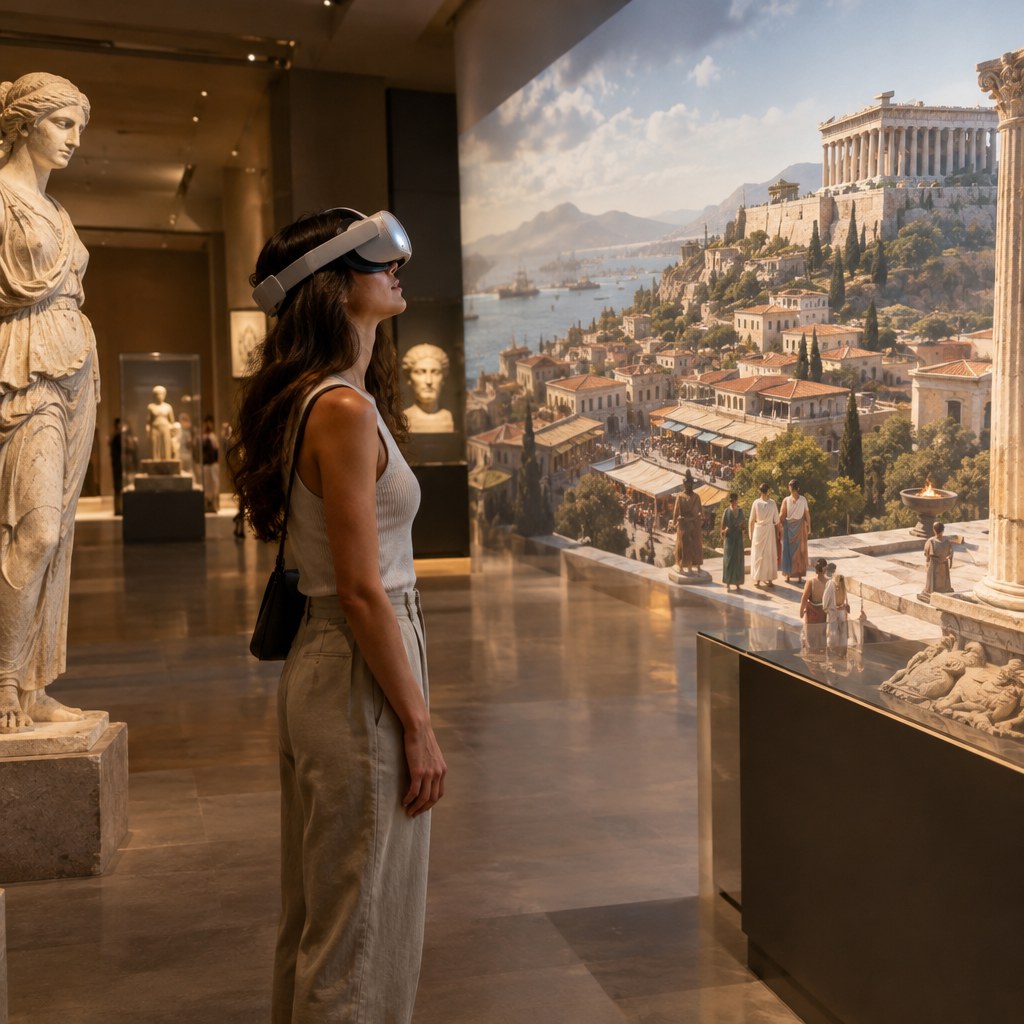
A fragment of masonry or a small architectural model can be difficult to interpret without its original setting. A well-designed virtual reality experience gives that fragment context. Visitors can enter a historically informed reconstruction, move through a vanished street or building, and experience how spaces relate to one another.
VR is especially valuable when a place is inaccessible, damaged, lost or too fragile for public access. An immersive presentation may reveal an earlier phase of a site without altering the original environment. Guided journeys can also connect multiple time periods, allowing visitors to understand how a town, monument or everyday practice changed over centuries.
However, immersion alone is not the goal. Clear narration, thoughtful pacing and curatorial review matter more than visual spectacle. The most effective experiences make the historical question easy to understand and leave room for visitors to reflect.
Explore our virtual reality development services and our introduction to VR cultural heritage experiences.
2. Augmented reality adds context without replacing the original
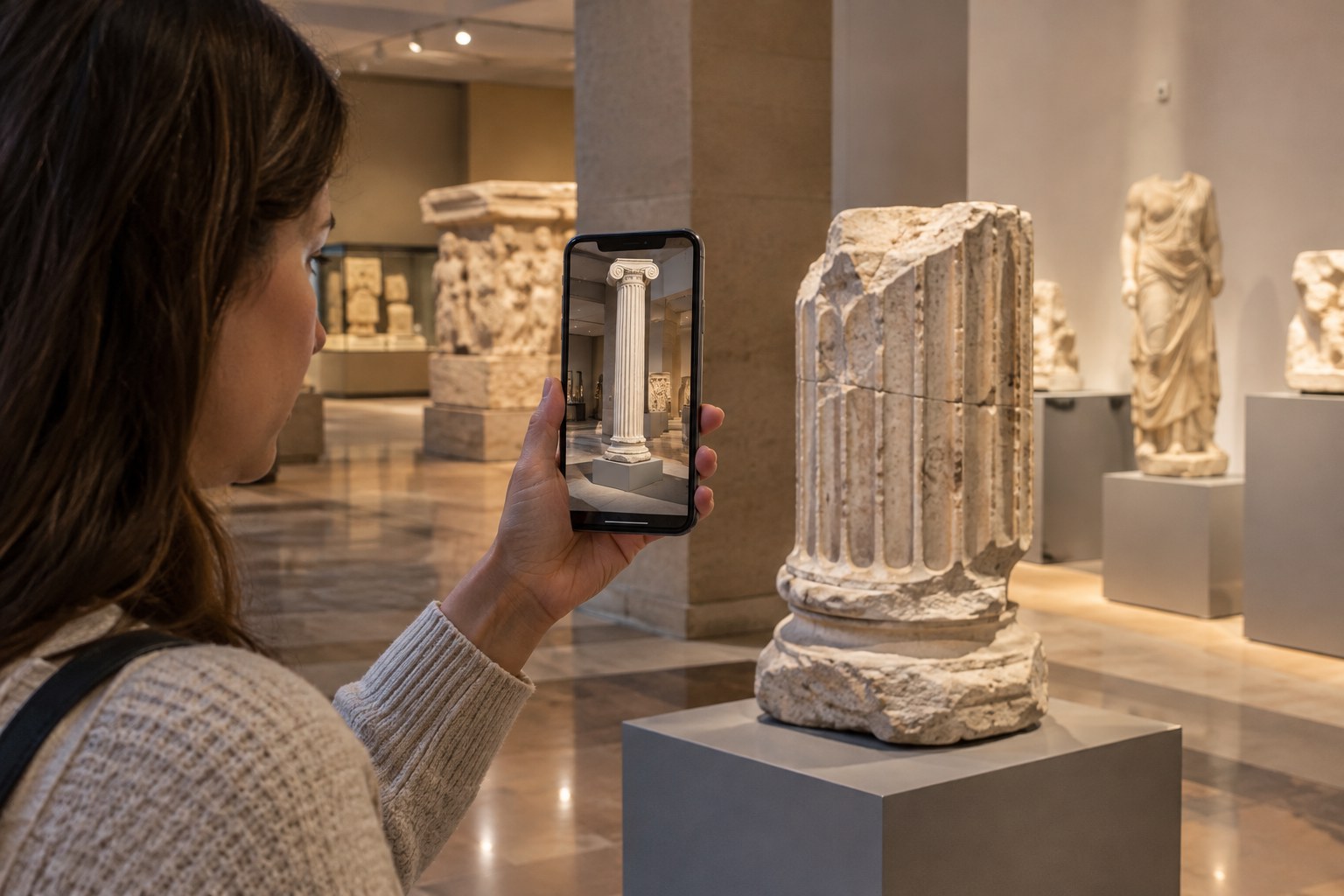
Augmented reality (AR) overlays digital information onto a visitor’s view of the physical world. In a gallery, a phone or tablet can show how a broken object may once have looked. At an archaeological site, AR can help visitors compare visible remains with a possible reconstruction of the original architecture.
Because AR keeps the real object or place at the center of the experience, it is a useful option for collections where physical authenticity is essential. Visitors remain aware of their surroundings while discovering additional layers of interpretation.
The experience should also distinguish documented evidence from interpretive reconstruction. A simple label, visual treatment or explanatory note helps preserve trust when a detail is uncertain.
See how we approach augmented reality solutions for exhibitions and visitor experiences.
3. Interactive 3D makes exploration part of learning
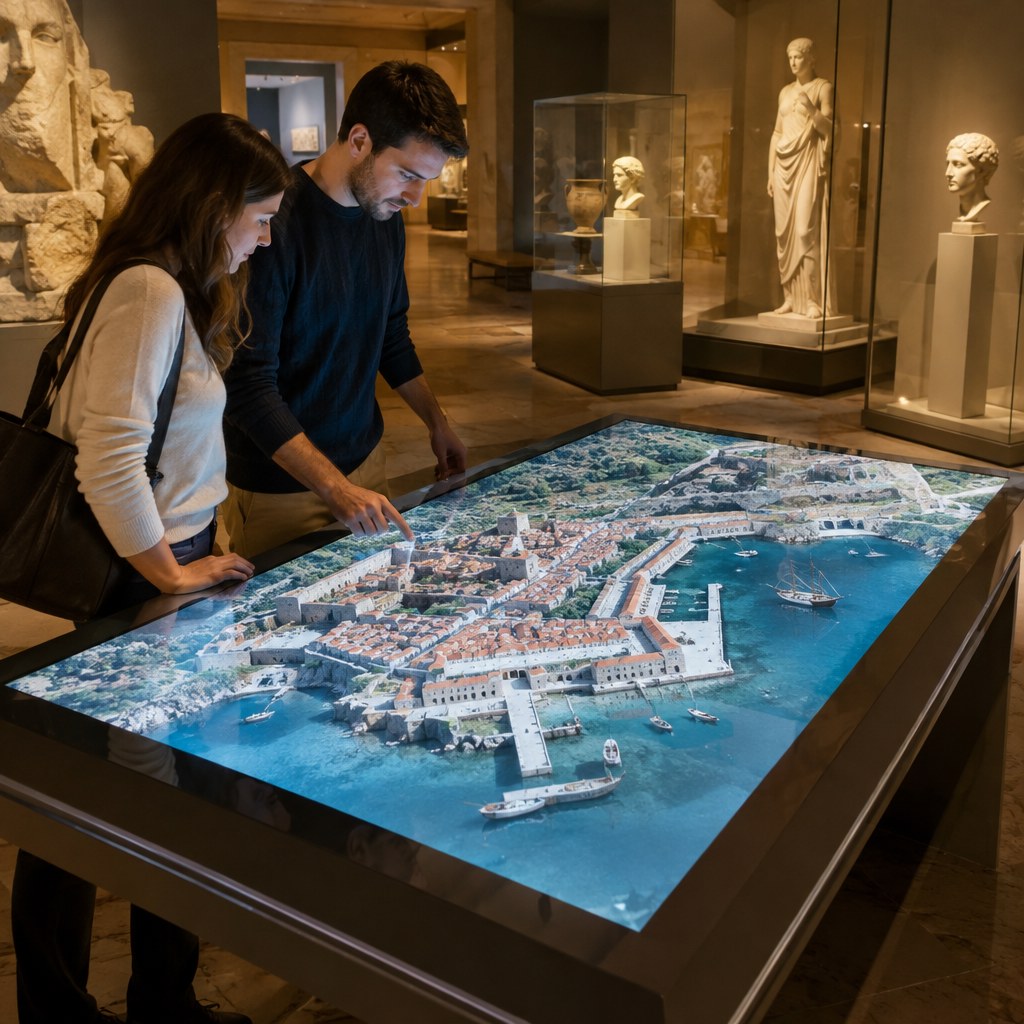
Interactive 3D gives visitors control over what they examine. Rather than watching a fixed video, they might rotate a digitized artifact, open a cutaway view, compare two construction phases or select a location on a digital map. A touchscreen can make these interactions accessible to families, school groups and visitors who prefer not to wear a headset.
For example, an archaeological museum could use an interactive model of an ancient harbor to connect shipbuilding, trade routes, architecture and everyday life. Selecting a building could reveal its function; choosing a period could show how the settlement evolved. The model becomes an interface for discovery, rather than decoration.
Interactive installations can be designed for large public displays, touch tables or web browsers. Our work in 3D visualization and animation and gesture-based interactive applications offers different ways to turn complex information into something visitors can explore.
4. Digital storytelling brings different audiences into the same narrative
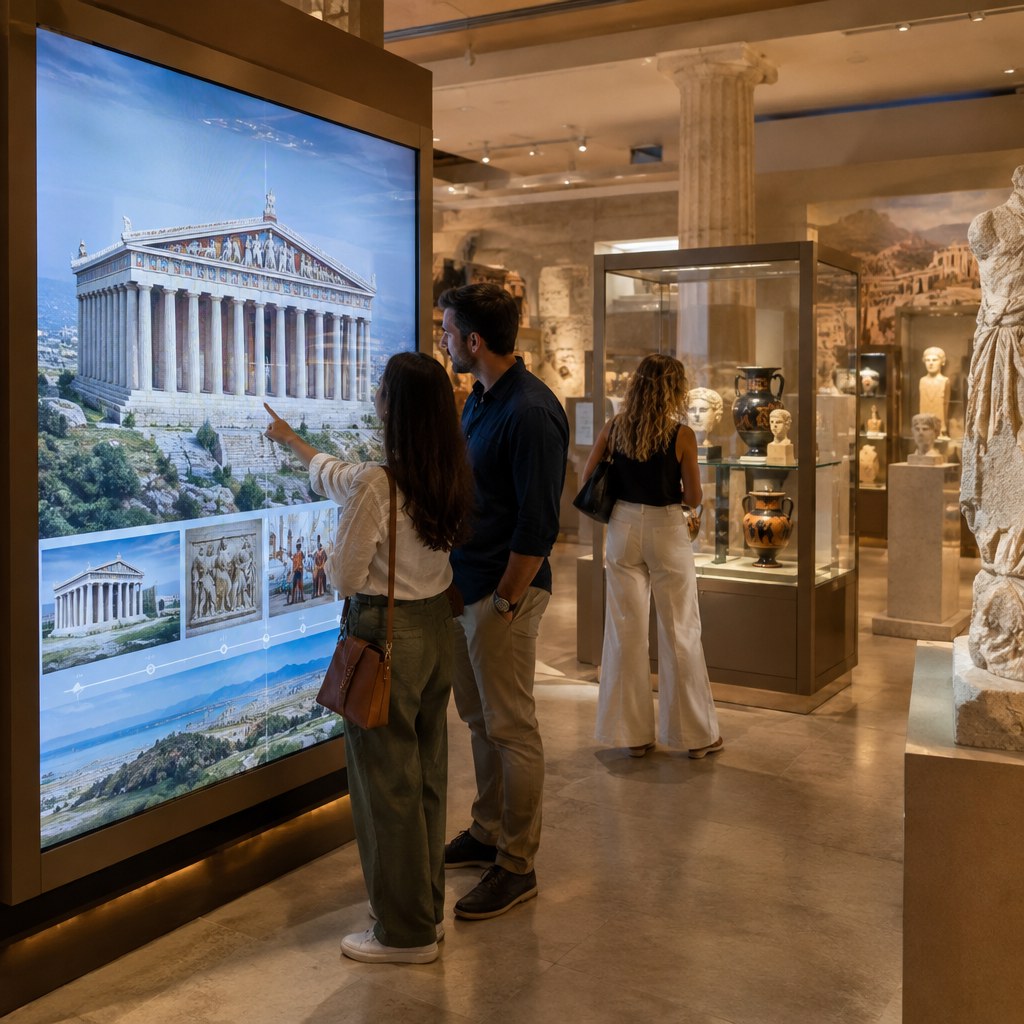
Not every visitor arrives with the same knowledge, language or interests. Digital storytelling offers different routes into a collection: a short guided experience for first-time visitors, deeper material for enthusiasts, and accessible alternatives for visitors who cannot use particular devices.
Audio narration, subtitles, multiple languages, simple navigation and clear interaction prompts all support inclusion. An exhibition can combine a dramatic reconstruction with quieter options such as a captioned video, a tactile model or an on-screen timeline. These are not compromises; they are ways to make heritage interpretation more useful to a wider audience.
Importantly, technology should remain a choice. Visitors must still be able to appreciate the collection without being required to use an app or headset.
5. VR and AR in museums: choosing the right format
Each technology solves a different visitor-experience problem. Before selecting hardware, museums should identify what people need to see, understand or do.
- Choose VR when the experience depends on entering a lost, remote or difficult-to-access place, or on understanding the scale of an environment.
- Choose AR when the real artifact or site must stay visible and a contextual digital layer will clarify what visitors are looking at.
- Choose interactive 3D when visitors should compare, inspect and explore information together on a touchscreen or accessible web interface.
These approaches can also work together. A museum might use an interactive map in the main gallery, an AR experience beside selected artifacts and a brief VR journey in a dedicated interpretation area.
6. Historical accuracy and museum operations come first
A compelling digital experience is built on a reliable interpretation process. Historical references, archival imagery, 3D scans, architectural research and the museum’s own curatorial expertise should guide the production. Where evidence is incomplete, the experience needs to communicate uncertainty rather than present speculation as fact.
Practical operations matter just as much. A museum installation needs straightforward controls, durable equipment, staff-friendly startup procedures and a content update plan. For VR headsets, teams should also plan for visitor supervision, hygiene, comfortable session lengths and non-VR alternatives.
Accessibility should be evaluated early, not after the experience is finished. Captions, readable type, contrast, language choices, clear audio, seated-use options and straightforward navigation can significantly improve usability for different visitors.
7. How to plan a successful digital heritage project
A practical development process starts with the story, not the device. Five steps help cultural organizations make informed decisions:
- Define an interpretive objective. What should visitors understand or remember after the experience?
- Choose the audience and setting. Consider school groups, international visitors, circulation, accessibility and staff capacity.
- Validate the content. Agree on historical sources, reconstruction assumptions and curator approval checkpoints.
- Prototype with real visitors. Test legibility, navigation, dwell time, comfort and whether the interaction supports the story.
- Plan for long-term use. Specify maintenance, supported devices, content ownership and a process for future updates.
Success can be evaluated through observation and visitor feedback, rather than assuming that more interaction automatically means better learning. Museums can look at completion rates, comprehension, repeat use and accessibility feedback to refine the installation.
8. Creating meaningful cultural heritage experiences with Fourthedesign
At Fourthedesign, we combine visual storytelling, 3D production and interactive development to help museums and cultural organizations communicate complex subjects. Our approach connects the historical narrative with the appropriate digital format—from immersive VR to AR interpretation and interactive 3D exhibits.
For a closer look at our areas of work, visit Cultural Heritage & Travel or browse our VR, AR and 3D case studies. Each project should be shaped around the collection, the venue and the people who will use it.
Frequently asked questions
Can small museums use VR or AR?
Yes. A focused experience around one artifact, a short interpretive scene or a browser-based 3D model can be a better first step than a large multi-room installation. Scope should follow the museum’s goals and available resources.
Does an interactive installation replace traditional exhibits?
No. Digital experiences work best when they complement original objects, curatorial interpretation and face-to-face learning. The collection remains the reason for the visit.
How can museums keep digital reconstructions historically credible?
By documenting source material, involving curators throughout development and clearly identifying elements that are hypothetical or reconstructed from incomplete evidence.
Bring your museum’s story to life
Planning a new exhibition, heritage interpretation project or immersive visitor experience? Contact the Fourthedesign team to discuss how VR, AR and interactive 3D could support your content, audience and venue.

