AR Development Companies in Greece: What to Look For
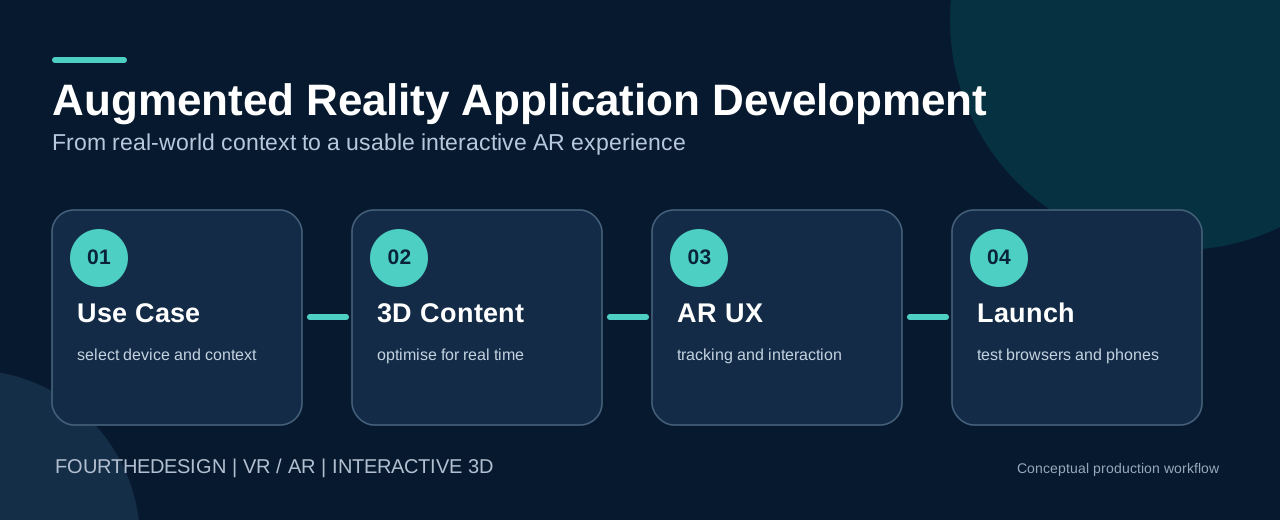
Which skills should you look for in AR development companies in Greece? Augmented reality is not one single technology or product. An AR museum guide, a browser-based marketing campaign and a mobile 3D product viewer have different requirements. The right development partner needs to understand user experience, 3D content, device capabilities and how the experience will be delivered to real people.
Fourthedesign develops interactive 3D, AR, VR and digital visualisation applications in Greece. The company’s experience in 3D modelling, animation, architectural visualisation and software development supports AR experiences for cultural heritage, products, exhibitions, business and education. This guide focuses on verifiable capabilities rather than unsupported rankings of “best AR companies.”

What does an AR application development company provide?
An augmented reality application adds digital 3D objects, animation or information to the user’s perception of a physical environment. This can be delivered through compatible mobile devices, tablets or specialised hardware. The implementation might use image markers, QR-initiated content, plane detection, object recognition, location data or other tracking approaches, depending on the requirements and platform.
A professional AR project combines 3D production, application development, interaction design, device testing and content management. Clear onboarding is essential: users should understand what to scan, where to point the camera, how to place the digital content and how to return to the main application.
AR companies in Greece: the practical technology choices
Native AR applications for Android and iOS
Native mobile applications can use supported AR frameworks and device sensors for environmental understanding and object placement. They may be suitable for complex tracking, ongoing experiences, content access and integrations. The application must be tested across its intended devices and operating-system versions.
WebAR and QR-based augmented reality
WebAR allows suitable experiences to launch in a compatible browser, often following a QR scan without a separate app installation. It can be useful for public-facing campaigns, events and product discovery. However, browser AR support and capabilities vary widely: not every feature available in a native AR app works on every mobile browser.
3D models, character animation and interaction
The 3D asset itself is a major part of the visitor experience. It may need an accurate shape, carefully designed textures, motion, sound, interaction states and optimisation for mobile performance. A character-led AR experience also depends on storytelling, animation and clear instructions rather than only technical tracking.
AR for museums, archaeology and cultural heritage
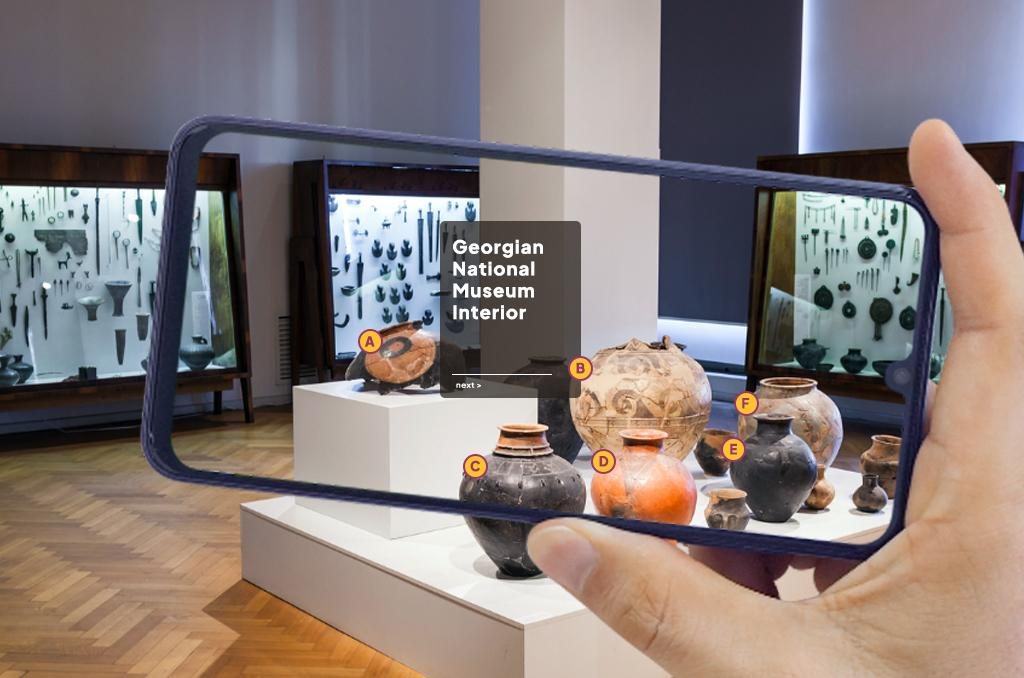
Augmented reality can add context while keeping the original artefact or physical site visible. A museum guide may show how an object was used, animate a reconstruction, reveal hidden details or provide multilingual storytelling. Historical interpretations should be approved by the institution and distinguish documented evidence from assumptions.
A relevant published example is the Heraklion Archaeological Museum AR application. Fourthedesign worked on AR application development and visual production for the project, with content including 3D representations, animation and an interactive activity around a Minoan vase. The experience is a useful example of visitor-centred AR rather than a general technology demonstration.

WebAR for brands, retail and interactive campaigns
For a marketing campaign or retail activation, friction can make or break the experience. People may interact once, on a personal phone, in a noisy store or at an event. An AR experience in this setting should have a short route from QR code to first interaction, obvious controls and content that loads efficiently over typical mobile connections.
Fourthedesign’s AVOLTA browser-based AR project is a published example involving an interactive 3D mascot and customisation features. It illustrates how browser delivery and character-led content can support digital engagement. The case study should be assessed on its described functionality, not as a promise that all devices offer identical AR capabilities.
AR for architecture and product visualisation
Architectural AR can help communicate a proposed building, product or interior element in a real setting. A viewer may place a digital model in a physical room or look at selected details from different angles. Scale accuracy, surface tracking, lighting, device performance and correct spatial alignment all require careful testing.
Fourthedesign’s long-standing practice in architectural 3D visualisation and real-time 3D applications complements AR production. Depending on a client’s goals, a browser-based 3D presentation may be more appropriate than AR if users primarily need to select apartments, review floor plans or compare units.
How to brief an AR development company in Greece
- Audience and objective: define who will use the AR experience and what action should follow.
- Delivery channel: specify whether an app download is acceptable or a QR-linked browser experience is essential.
- Target devices: list smartphones, tablets, operating systems, browser versions and any provided hardware.
- Tracking approach: decide whether an image, QR code, surface, object or location triggers the content.
- 3D content: describe the models, animation states, realism, audio, supported gestures and source material.
- Information and privacy: clarify analytics, user data, permissions and any external integrations.
- Quality assurance: test recognition, lighting, placement, navigation, accessibility and low-performing devices.
- Handover: agree on source assets, deployed app or URL, documentation, hosting, maintenance and updates.
The most convincing proof of capability is a relevant delivered project and a realistic prototype on the devices the audience will use—not a self-declared ranking.
Does an AR application need an internet connection?
That depends on the chosen architecture. Some native applications can store content locally and provide offline functions. WebAR commonly needs an initial network connection to access the application and assets. Offline behaviour, content caching and external API dependencies should be specified individually rather than assumed.
How much does a custom AR project cost?
AR budgets depend on the quantity and complexity of 3D assets, animation, tracking technique, number of scenes, platform support, localisation, content management, external integrations and testing. A simple promotional 3D viewer and a multi-location museum AR guide are not comparable scopes. Ask for separate estimates for asset creation, software, licensing, deployment and support.
Frequently asked questions about AR companies in Greece
Can AR work without downloading a mobile app?
Yes, suitable WebAR experiences can run in supported browsers. Advanced tracking or integration features may require a native implementation and device-specific testing.
Can AR show a full-sized 3D building?
Some AR experiences can present architectural content at large scales, but spatial accuracy, tracking and device compatibility vary. They are visualisation tools, not automatically a substitute for measured construction data.
Is WebAR the same as simply viewing a 3D model online?
No. An interactive 3D browser viewer displays content on screen. WebAR adds camera-based or environmental presentation when the platform supports it. Both can be useful within a larger project.
What files are needed to start an AR project?
Depending on the use case, existing 3D/CAD files, product photographs, architectural drawings, branding material, image targets, audio scripts and multilingual texts can form the source material.
Why choose an AR team with 3D animation experience?
Visual asset quality and real-time optimisation often determine whether the experience is convincing and responsive. Animation expertise also supports characters, product stories and explanatory sequences.
AR Development in Greece by Fourthedesign
WebAR, native augmented reality, animated 3D and interactive digital experiences.
Related: Augmented reality development services · Fourthedesign project case studies · How to choose a VR/AR development company.

