VR Development Companies in Greece: What to Look For
Looking for VR development companies in Greece? The key question is not which studio claims to be “number one.” It is whether a team can design, produce and support the virtual reality application your audience needs. From museum storytelling and immersive training to real estate walkthroughs and industrial simulations, VR projects require a combination of technical and creative skills.
Fourthedesign is a Greece-based company delivering 3D modelling, architectural visualisation, animation, interactive 3D, VR and AR application development. With a long-standing background in digital visual production, the team works across heritage, education, business, industrial and medical communication. This guide explains what professional VR development includes and what to consider before commissioning a project.

What does a VR application development company do?
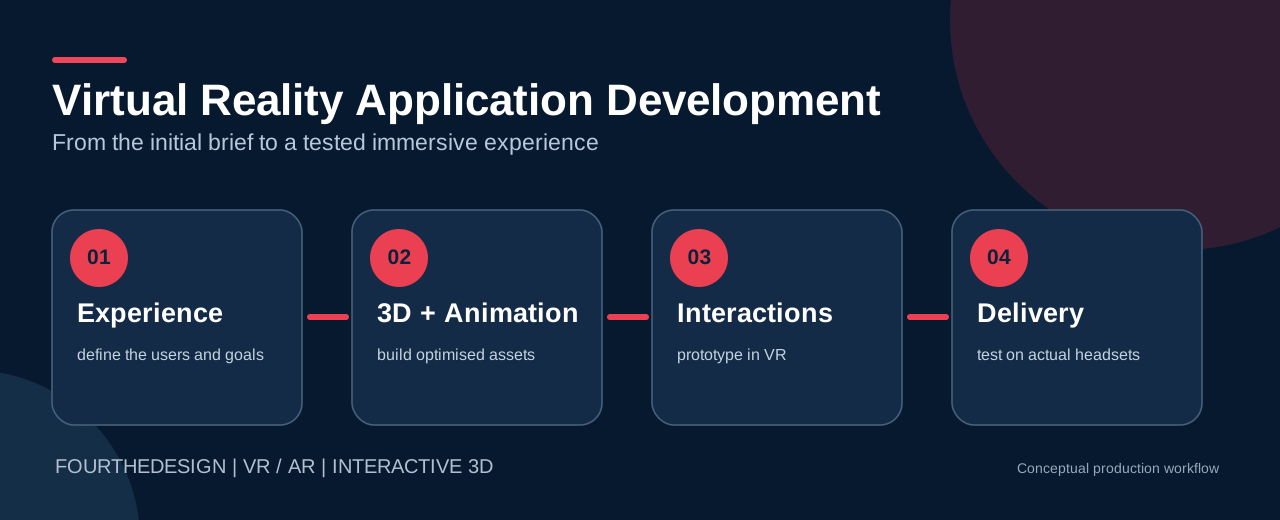
A virtual reality development company creates interactive applications that place a user inside a computer-generated environment, normally through a compatible VR headset. The work can involve environment design, 3D asset creation, interface and interaction design, animation, spatial sound, software programming, device testing and deployment.
Professional VR development is more than producing photorealistic images. A scene that looks excellent in a video may still need substantial optimisation and interaction logic to run consistently on standalone headsets. A real project also needs clear instructions, comfortable navigation, a recovery path when users get stuck and a plan for future software updates.
VR companies in Greece: which capabilities matter?
3D modelling, visualisation and animation
Reliable immersive experiences begin with fit-for-purpose 3D content. Architecture, museum assets, industrial machines and scientific models have different requirements for accuracy, performance and appearance. A team able to prepare, animate and optimise assets internally can streamline the development process, though scope and asset ownership should still be agreed in writing.
Real-time VR application programming
VR applications need responsive interactions, input handling, navigation, appropriate UI/UX, frame-rate stability and robust builds for the target device. Developers must consider hardware limits, content loading, controllers, seated or standing use and testing on the exact headsets expected at delivery.
Storytelling, user experience and accessibility
A museum visitor putting on a headset for the first time needs different instructions from an experienced industrial trainee. Narration, session duration, text size, interaction prompts and accessible alternatives should be considered during early design. Not every audience should be expected to use immersive equipment in the same way.
VR applications for museums and cultural heritage
VR can help visitors explore places that are distant, inaccessible or no longer exist in their historic form. It can provide spatial context for objects and bring an authored narrative into a three-dimensional environment. For heritage projects, curatorial review is essential: documented evidence should be distinguished from interpretative reconstruction.
One example is the Nikos Kazantzakis immersive VR experience. Fourthedesign’s published contribution as a subcontractor includes VR visualisation, recreation of a literary environment, 3D assets, character rigging and animation. The project illustrates how digital characters and scene design can support cultural storytelling.
Another published example is Modern History of Crete VR, where Fourthedesign’s documented subcontracted contribution includes immersive environments and 3D/animation work. See also our guide to VR, AR and interactive 3D for museums.

VR training applications for industry and professional learning
Training applications are built around actions and feedback rather than passive observation. A well-defined scenario may ask participants to identify a risk, inspect equipment, follow steps or practise a decision sequence. Real technical procedures should be validated with domain experts. VR can complement instruction but does not automatically replace hands-on certification or supervised practice.
The C-MineTech industrial VR training and digital twin project demonstrates Fourthedesign’s published work on immersive industrial content, simulations and real-time visualisation. Its training context involves raw materials and circular-economy skills. The value lies in connecting complex domain material with usable 3D interaction.

Architectural VR and real estate presentations
VR architecture gives potential buyers and project teams a stronger feeling of spatial scale than floor plans alone. A real-time walkthrough can present a proposed interior or development and allow visitors to move through selected spaces. For some sales workflows, a web-based 3D platform or a touchscreen may be more convenient than a headset.
Fourthedesign combines photorealistic architectural visualisation with real-time interactive architecture and 3D animation. Read about web-based 3D building presentations when online distribution, apartment selection or sales interfaces are priorities.
Medical and scientific VR visualisation
VR can also present abstract scientific concepts through space, motion and interactive explanation. Medical and pharmaceutical visualisations demand subject-matter review, accurate terminology and careful separation between educational communication and clinical claims. A visually compelling simulation should not be described as a validated medical device unless it truly is one.
Fourthedesign’s wider practice includes 3D medical animation and immersive pharmaceutical visualisation. This experience adds a different dimension to a company traditionally assessed only by architectural or museum showreels.
How to choose a VR development company in Greece
- Start with the objective: what should users learn, explore, practise or decide?
- Check relevant case studies: seek comparable delivered projects and understand the studio’s precise role.
- Agree on equipment: specify Meta Quest or other target devices and whether the experience must be seated, offline or managed by staff.
- Review production scope: distinguish existing models from new 3D production, animations and software features.
- Test a prototype: validate usability, performance and the core interaction before all content is built.
- Define handover: state what builds, licences, documentation, source assets, training and support are included.
- Plan maintenance: ensure the experience remains usable as headsets, operating systems and exhibits evolve.
There is no independent universal ranking that identifies one “best VR company” for every museum, training centre, industrial client or property developer. The right choice depends on a confirmed project scope and relevant delivery evidence.
How much does custom VR application development cost?
A responsible quotation follows the technical brief. Cost varies with the number of environments, quantity of custom 3D models, visual detail, interactive scenarios, characters, supported headsets, languages, voice-over, testing, integration and maintenance. Simple guided experiences and multi-scenario training platforms should not be priced as interchangeable products.
Before requesting a quote, prepare the intended audience, hardware, source material, number of scenes, required languages, timeline, support expectations and any need for progress tracking or remote content updates. Ask for a breakdown of 3D content production, software development and ongoing support.
Frequently asked questions about VR development in Greece
Can a VR application run on standalone headsets?
Yes, when it is specifically designed and optimised for compatible devices. Complex scenes may need simplified models and careful performance testing.
Is a VR walkthrough the same as a 360° tour?
No. A panorama-based tour links fixed viewpoints, while real-time VR can allow more flexible navigation and object interaction, depending on the implementation.
Can existing 3D, BIM or CAD content be reused?
Often, but production assets may require conversion, optimisation, materials adjustment and new interaction logic before working as a real-time VR application.
Can VR be used for education without measured improvements being guaranteed?
Yes. It can provide an immersive practice or exploration format, but learning outcomes should be assessed for the specific audience and scenario rather than assumed.
Does Fourthedesign work only in Greece?
The company is based in Greece and has published work covering both Greek and international project contexts. Delivery locations and on-site requirements should be discussed for each project.
VR Development in Greece by Fourthedesign
3D animation, immersive software, interactive simulations and VR experiences.
Explore more: Fourthedesign case studies · VR development services · Choosing a VR/AR development partner.

