



VR Applications in Greece: Virtual Reality Development for Training, Healthcare, Real Estate and Culture
 A modern VR application can place an industrial employee inside a virtual production facility, allow a physician to explore a biological process from inside the human body, transport a museum visitor into another historical period, or let a potential property buyer walk through a development before it has been constructed.At Fourthedesign, we design and develop custom Virtual Reality, Augmented Reality and interactive 3D applications in Greece for clients in different industries. Our work combines real-time 3D graphics, interaction design, animation, simulation and immersive storytelling with platforms such as Meta Quest, standalone VR and PC-based VR systems.
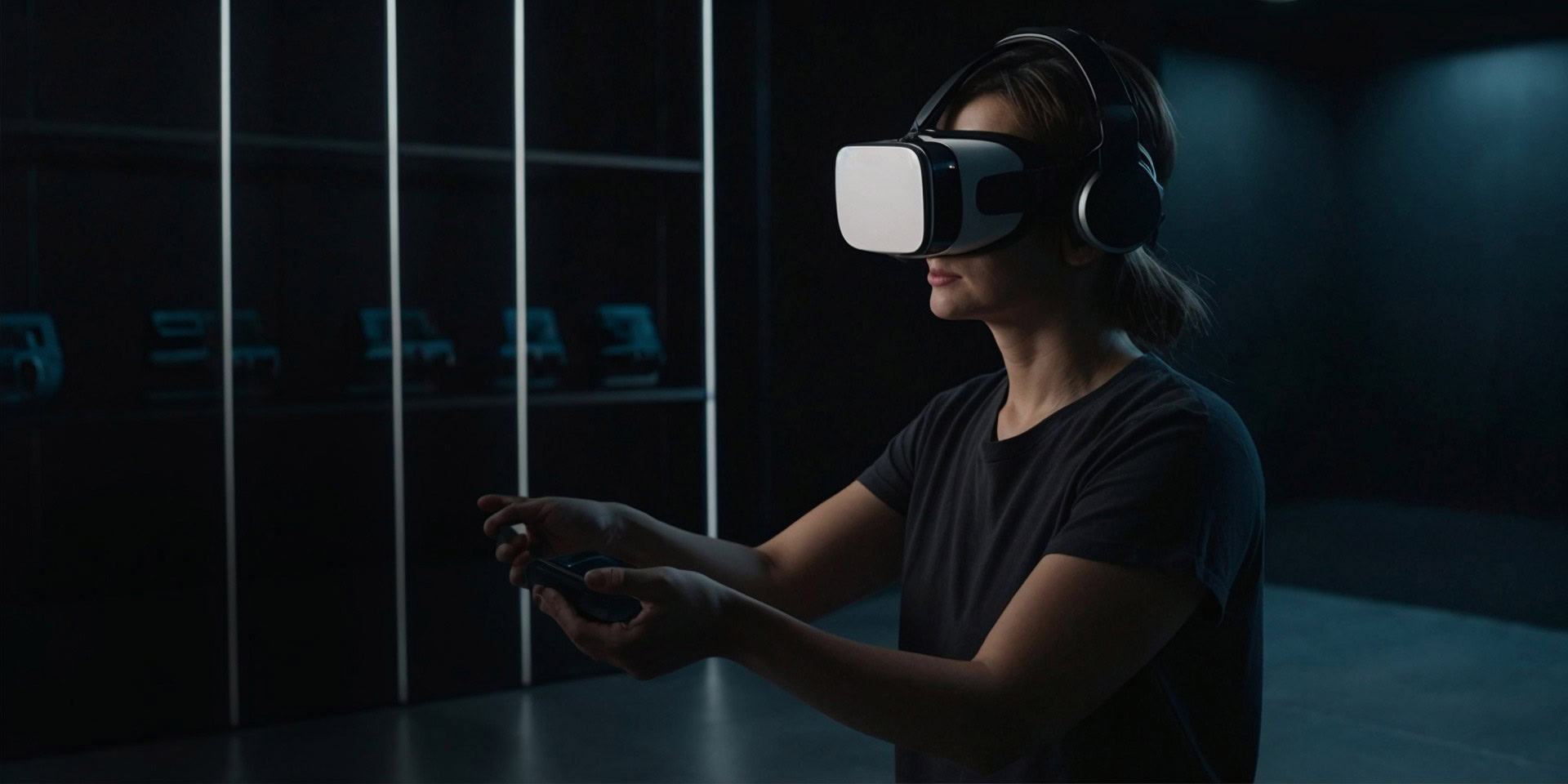
This guide looks at what professional VR can do, how organizations in Greece are already using it, what technologies are involved, and what a company should consider before starting a custom virtual reality project.
What Is a VR Application?
A VR application is an interactive digital experience that places the user inside a computer-generated three-dimensional environment. Unlike a conventional website, video or presentation, the user does not simply look at the content. They enter it.
Using a VR headset, users can look around naturally, move through a virtual space, interact with objects, perform tasks and receive immediate feedback. Depending on the project, they may be able to operate virtual machinery, explore a future building, follow an educational scenario, inspect medical equipment, interact with characters, practise an emergency procedure or collaborate with other users in the same environment.
This combination of scale, interaction, spatial understanding and simulation is what makes virtual reality different from conventional digital media. A video can show someone how to perform a task. A VR simulation can ask that person to perform it and react to what they do.
That distinction matters. The strongest professional VR applications are not built simply because VR looks impressive. They are built because immersion solves a practical communication, training, visualization or simulation problem.
Why Are VR Applications Growing in Greece?
Professional virtual reality used to require a powerful workstation, external sensors, cables and a dedicated installation area. Standalone headsets have changed that. Devices such as Meta Quest can run sophisticated real-time applications without a connected PC, making deployment much simpler for museums, training centers, sales offices, universities, exhibitions and corporate presentations.
That makes VR far more practical for organizations in Greece. A headset can be transported to an exhibition. A training application can be installed on several devices. A real-estate sales team can carry a complete virtual development to a meeting. A museum can run an immersive experience without building a computer workstation next to every visitor.
The best use cases usually have one or more of the following characteristics: risk, cost, complexity, physical scale, distance, limited access or the need to visualize something that does not yet exist.
For example, shutting down industrial equipment to practise a procedure can be expensive. Reproducing a dangerous accident for safety training would be irresponsible. Taking every student to a distant historical site may be impossible. Building an entire future property before showing it to a buyer is obviously not an option. VR creates a controlled digital version of those situations.
VR Training Applications in Greece
Industrial VR Training and Simulation
Industrial training is one of the clearest professional uses of virtual reality. Many procedures involve expensive machinery, safety risks, specialist environments or equipment that cannot be taken out of production every time a trainee needs practice.
Inside a VR simulation, a trainee can stand in front of a digital version of the equipment, follow a sequence of actions, identify components, make choices and receive immediate feedback. The same scenario can be repeated many times without consuming materials or interfering with the real facility.
Training scenarios can also include situations that are difficult to reproduce safely in reality, such as equipment failure, incorrect operation, emergency response, restricted areas or hazardous working conditions.
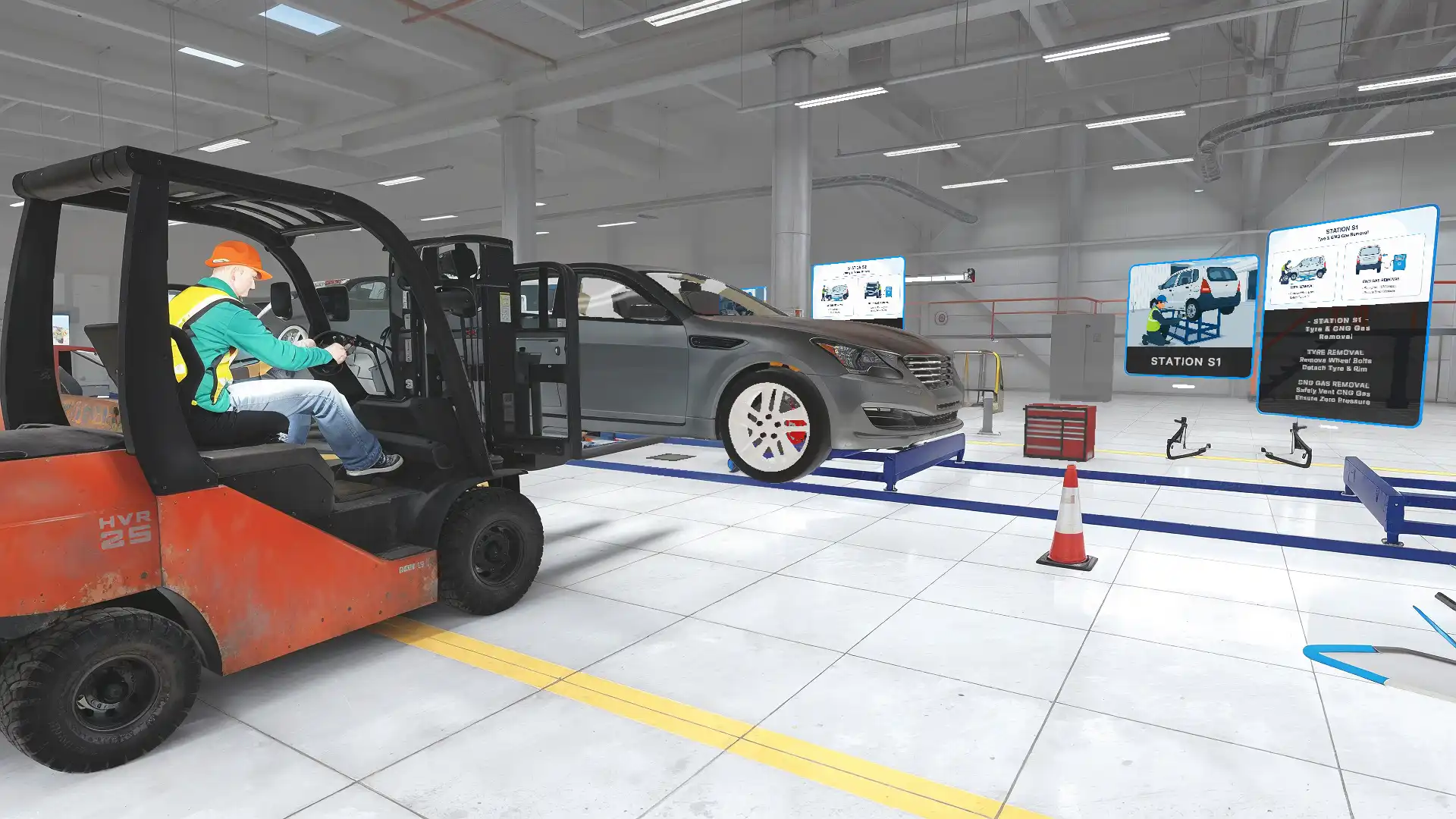
C-MineTech: Industrial VR Training and Digital Twins
A strong example is Fourthedesign’s work on C-MineTech, a European initiative connected with EIT RawMaterials. Fourthedesign participates as the immersive-technology partner, developing VR environments, interactive industrial simulations and digital-twin visualization for training in the raw-materials and circular-economy sector.
The project uses immersive scenarios around dismantling, sorting, material recovery and industrial safety. Instead of treating VR as a virtual showroom, the experience is structured around actions and procedures. Users can interact with equipment, follow training logic and understand processes spatially.
View the C-MineTech Industrial VR Training project →
VR Health and Safety Training
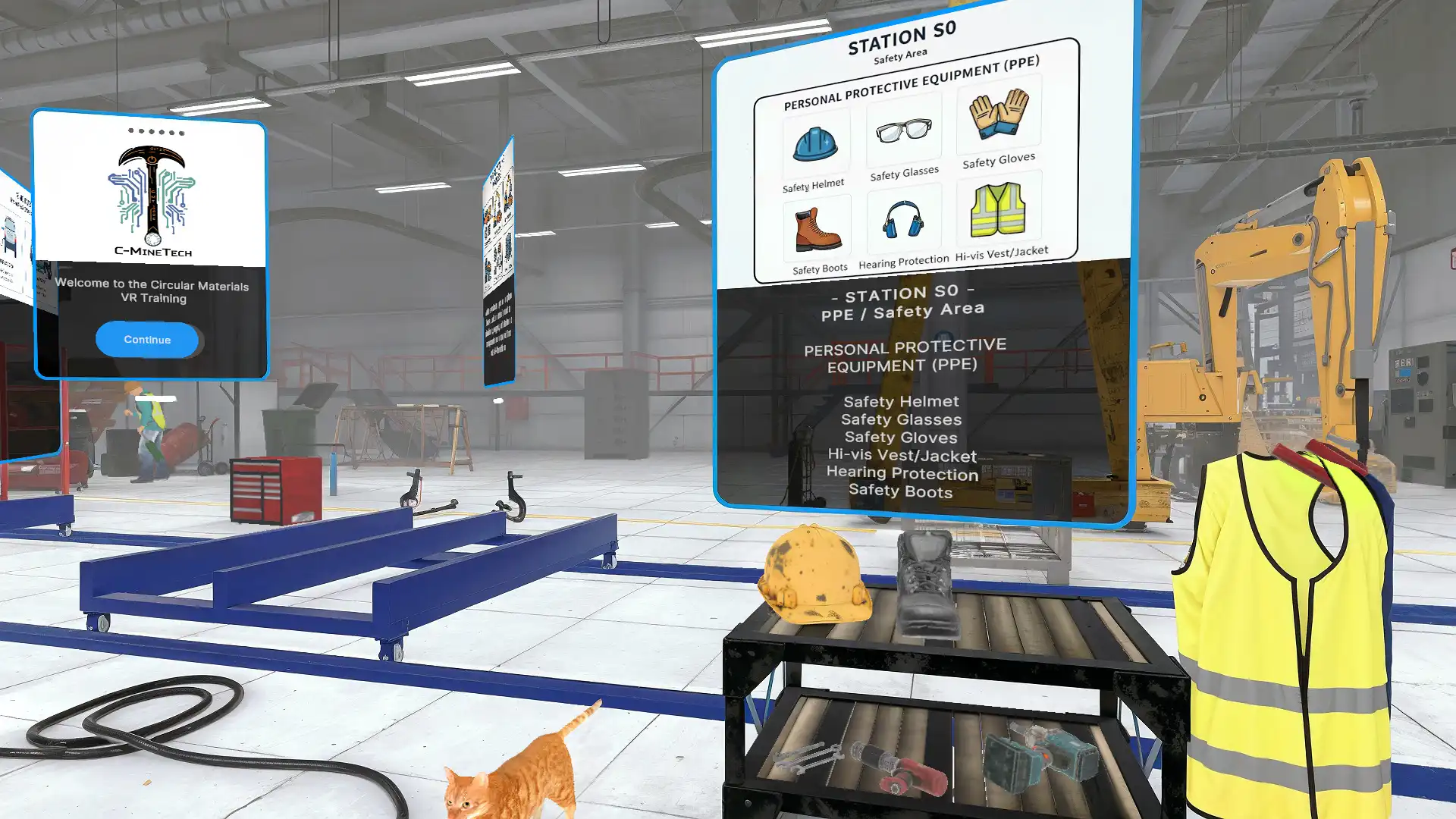
Health-and-safety training is another area where immersion has a very practical role. Traditional presentations and videos are useful for explaining rules, but a person can understand a hazard differently when they must recognize it while standing inside a simulated working environment.
VR can reproduce situations involving personal protective equipment, unsafe machinery use, falls, electrical risks, fire, evacuation procedures and other hazards without exposing anyone to real danger. The trainee can make a wrong choice, see the consequence and repeat the scenario.
For organizations with multiple sites, another advantage is consistency. The same environment, instructions, scenario logic and assessment criteria can be deployed to different users and locations. This does not replace real-world practical training, but it can create a valuable layer before, between or alongside physical sessions.
Medical VR Applications in Greece
Healthcare and pharmaceutical communication are particularly suited to immersive visualization because many medical subjects are spatial, complex or impossible to observe directly. Anatomy, microscopic biological mechanisms, medical devices and treatment processes can be difficult to explain with static diagrams alone.
Virtual reality allows those subjects to become environments. A learner can move around an anatomical structure, examine a process at a different scale, follow a biological mechanism, or interact with a digital medical device.
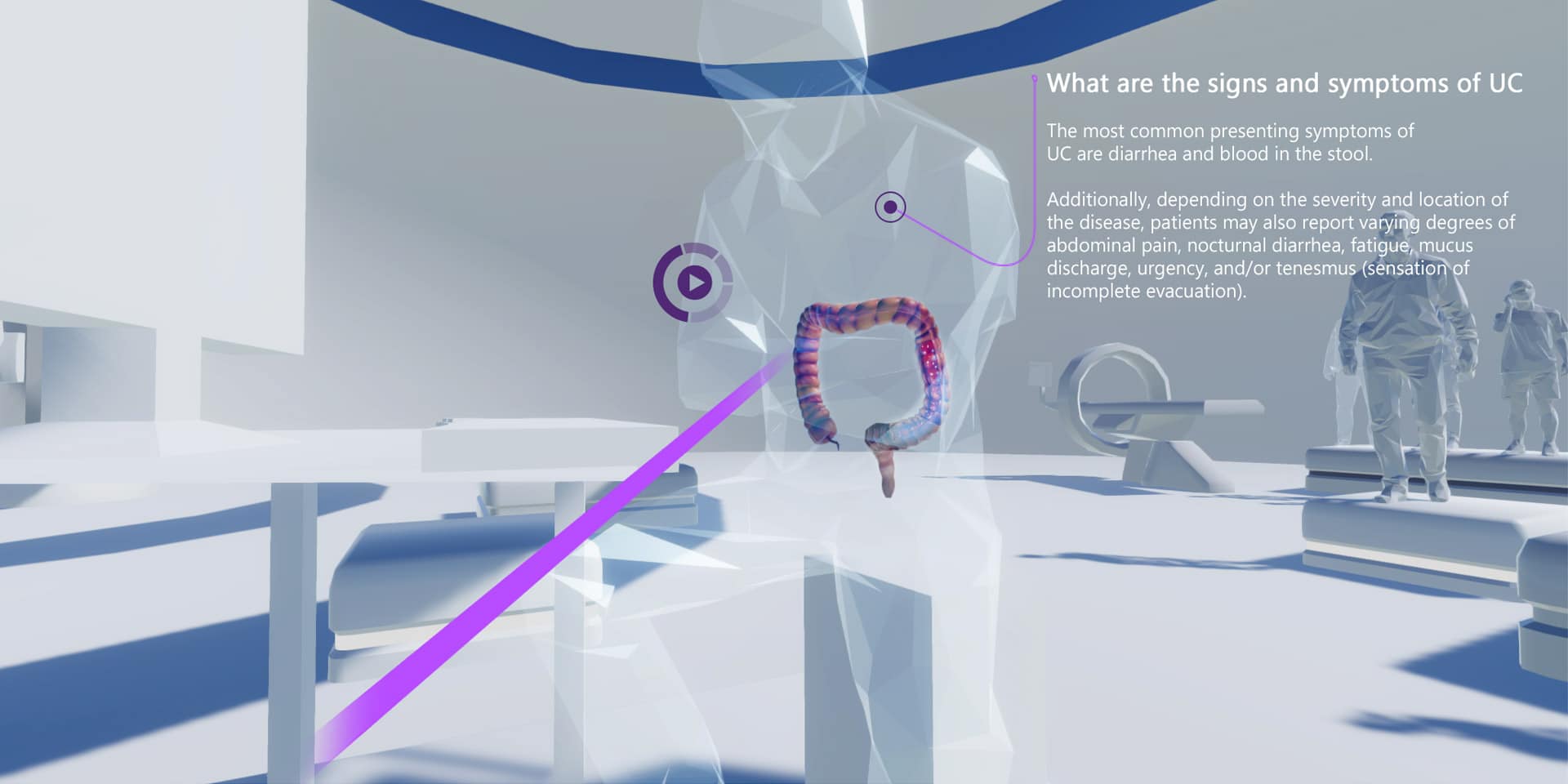
Janssen: Medical Education Through Virtual Reality
For a Janssen project focused on ulcerative colitis, Fourthedesign created an immersive medical VR experience that visualized the disease and related biological processes in three dimensions. The project allowed users to move from familiar human-scale environments into the microscopic world of the intestinal mucosa.
This is one of the areas where VR becomes especially useful. Something that is normally invisible or abstract can be translated into a spatial experience. The same approach can be adapted to medical education, pharmaceutical communication, mechanism-of-action visualization, patient information and professional training.
View the Janssen Medical VR project →
High-Fidelity Medical Equipment for Real-Time VR
Medical VR is not only about anatomy. Professional applications may also require accurate digital versions of real equipment. These models must be recognizable and detailed while still being efficient enough to run smoothly in a real-time environment.
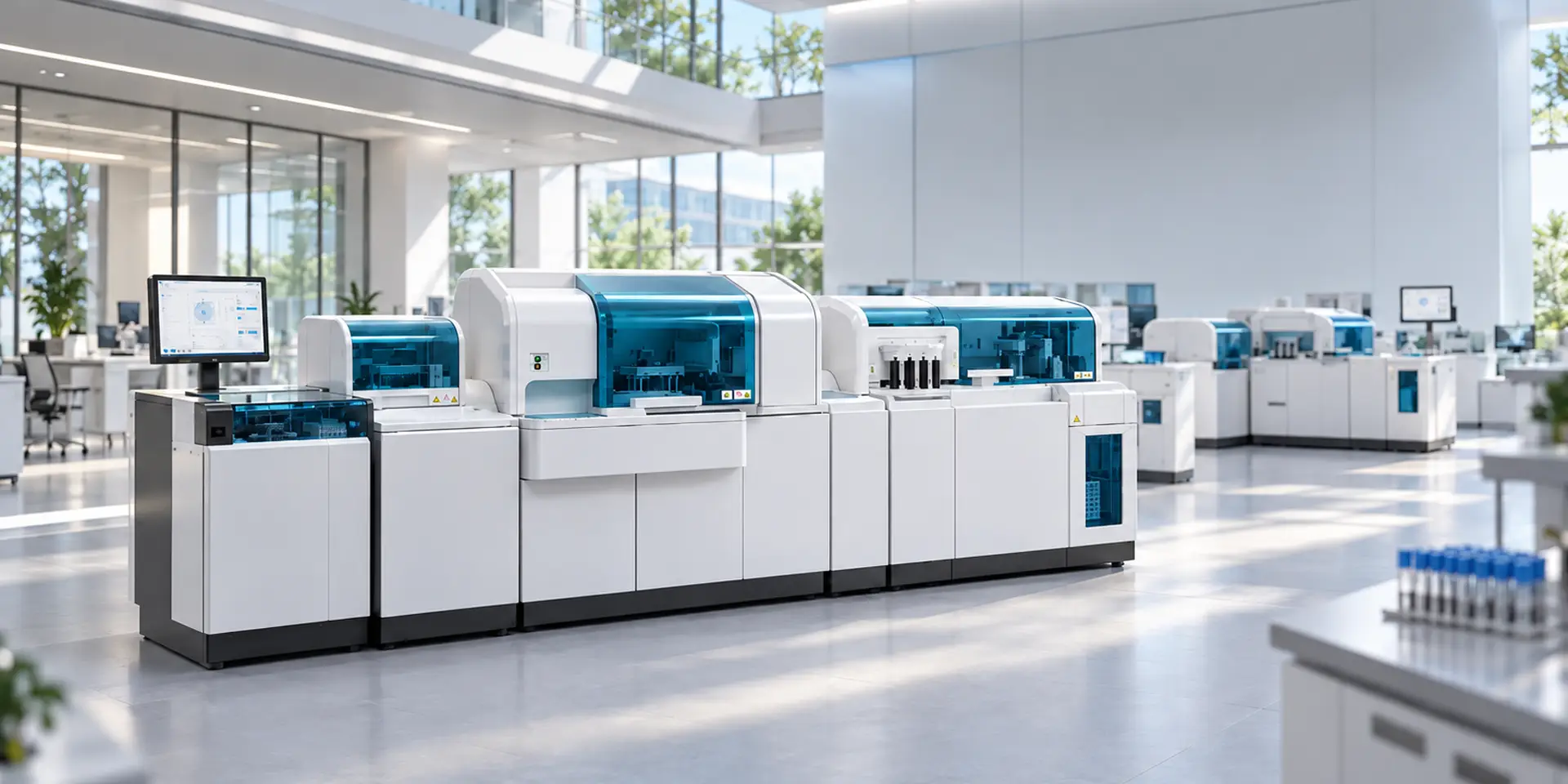
For Roche / OramaVR, Fourthedesign created detailed 3D models and animations of Roche cobas diagnostic systems using primarily photographic reference material. The models were optimized for real-time use so they could preserve important visual and mechanical detail without unnecessarily reducing VR performance.
View the Roche Medical VR 3D Modeling project →
VR Applications for Real Estate and Architecture
Architecture is naturally three-dimensional, but properties are still commonly presented through plans, still renders and video. These remain important tools, but VR adds a sense of scale and presence that a flat image cannot fully reproduce.
Inside a VR walkthrough, a buyer can understand how large a room feels, see the relationship between interior and exterior spaces, walk through a neighborhood and compare units before construction is complete. For international sales, VR is also portable: instead of bringing the buyer to the future development, the development can travel with the sales team inside a headset.
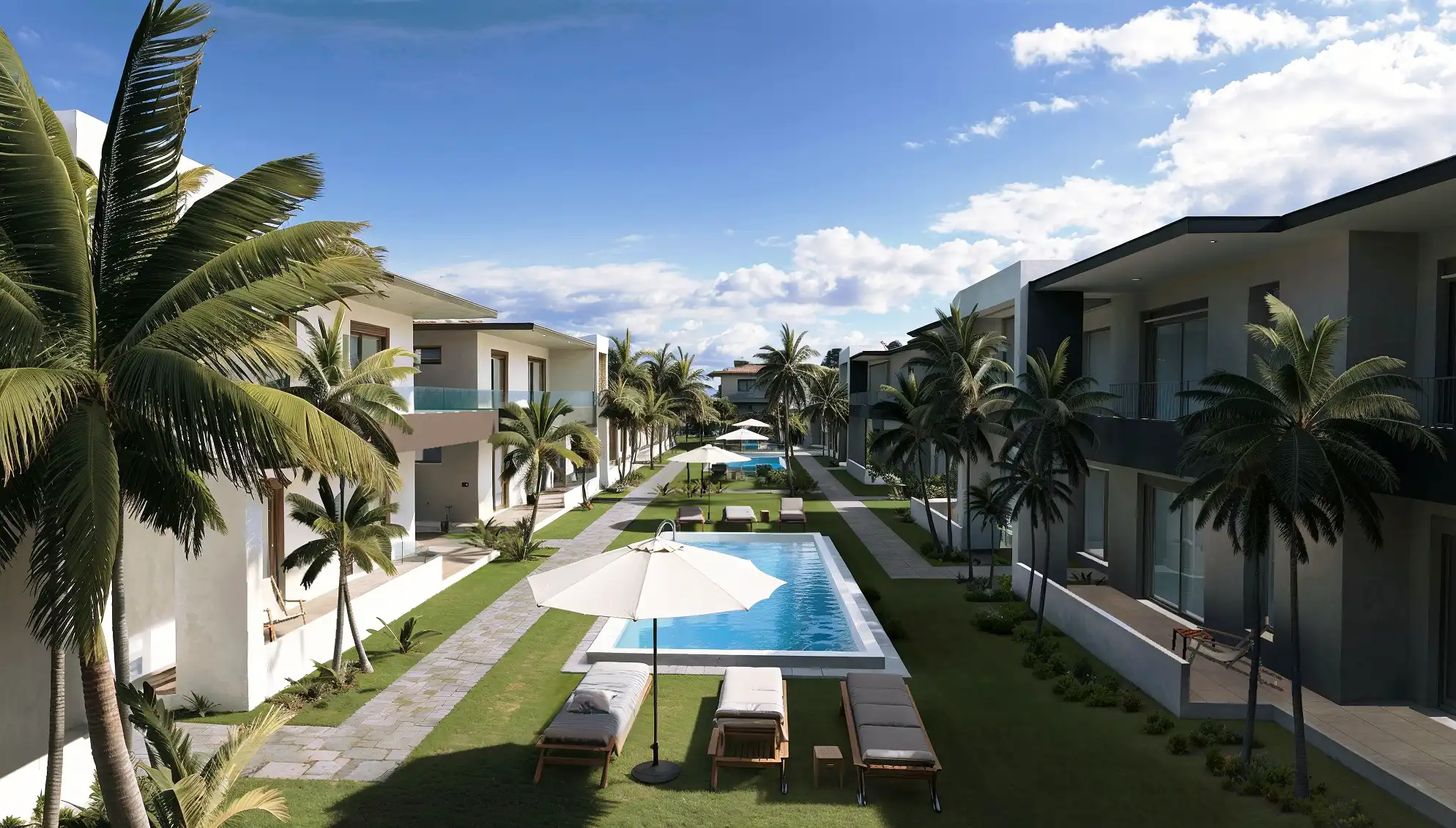
Kourtidis Group: A Complete Neighborhood Inside Meta Quest 3
For Kourtidis Group, Fourthedesign developed a standalone VR property-presentation system in which users can explore entire 3D areas, exterior spaces and detailed interiors on Meta Quest 3. The system begins in a virtual presentation environment where developments can be viewed as digital models before users move directly into the neighborhood or selected properties.
The project demonstrates an important point about professional VR development: visual quality matters, but performance matters just as much. Large environments must be carefully optimized so that movement and interaction remain smooth on standalone hardware.
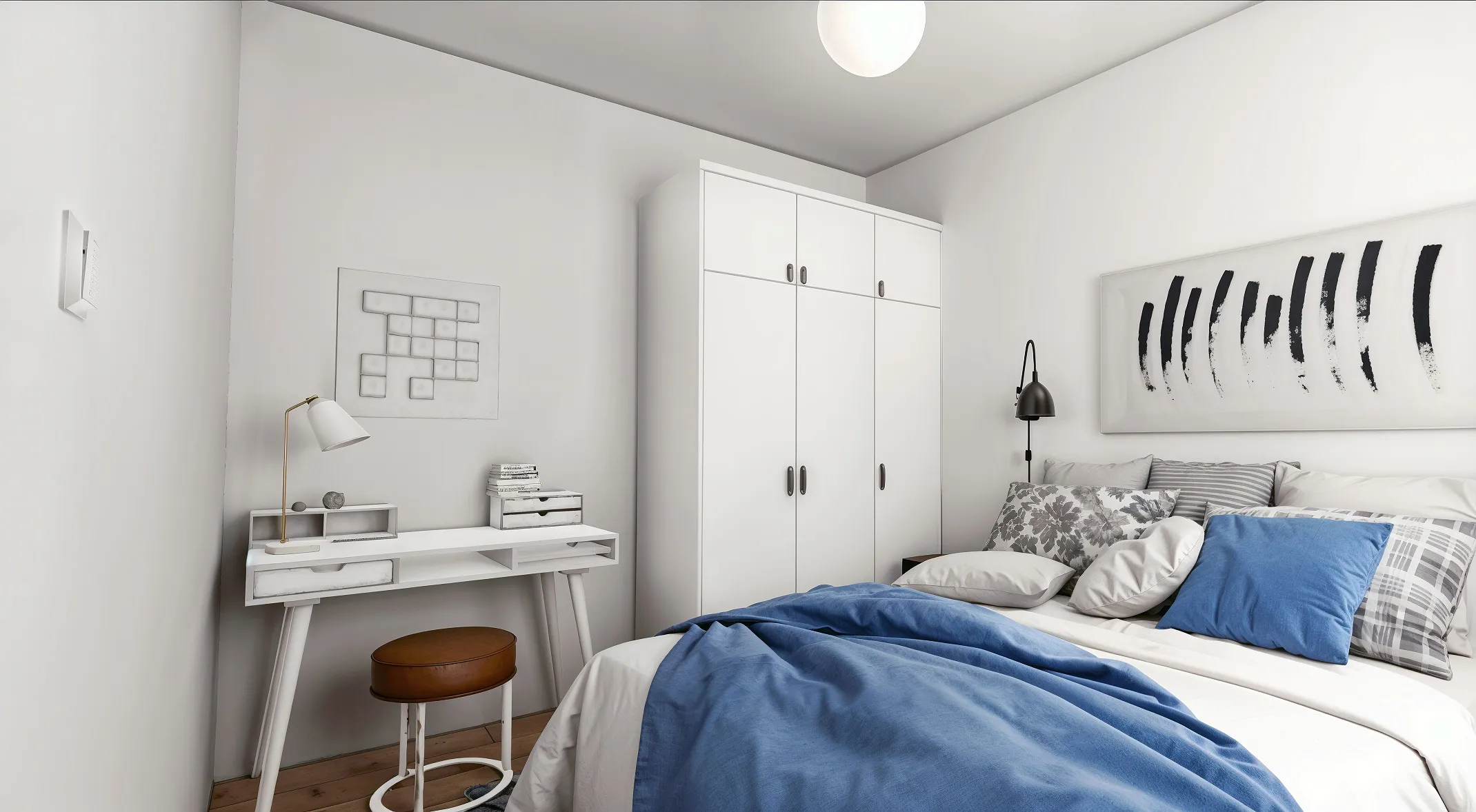
View the Kourtidis Group VR Real Estate project →
VR for Museums and Cultural Heritage in Greece
Greece has an obvious connection with history, archaeology and cultural heritage. Yet much of that history cannot be experienced directly. Buildings may no longer exist. Historical events cannot be recreated. Important objects may be too fragile to handle. Archival material is often two-dimensional and separated from the spaces where events originally took place.
Virtual reality can create a bridge between historical information and spatial experience. It can reconstruct an environment, place archival elements inside a 3D scene, introduce narrated characters and allow visitors to move through a story rather than only reading about it.
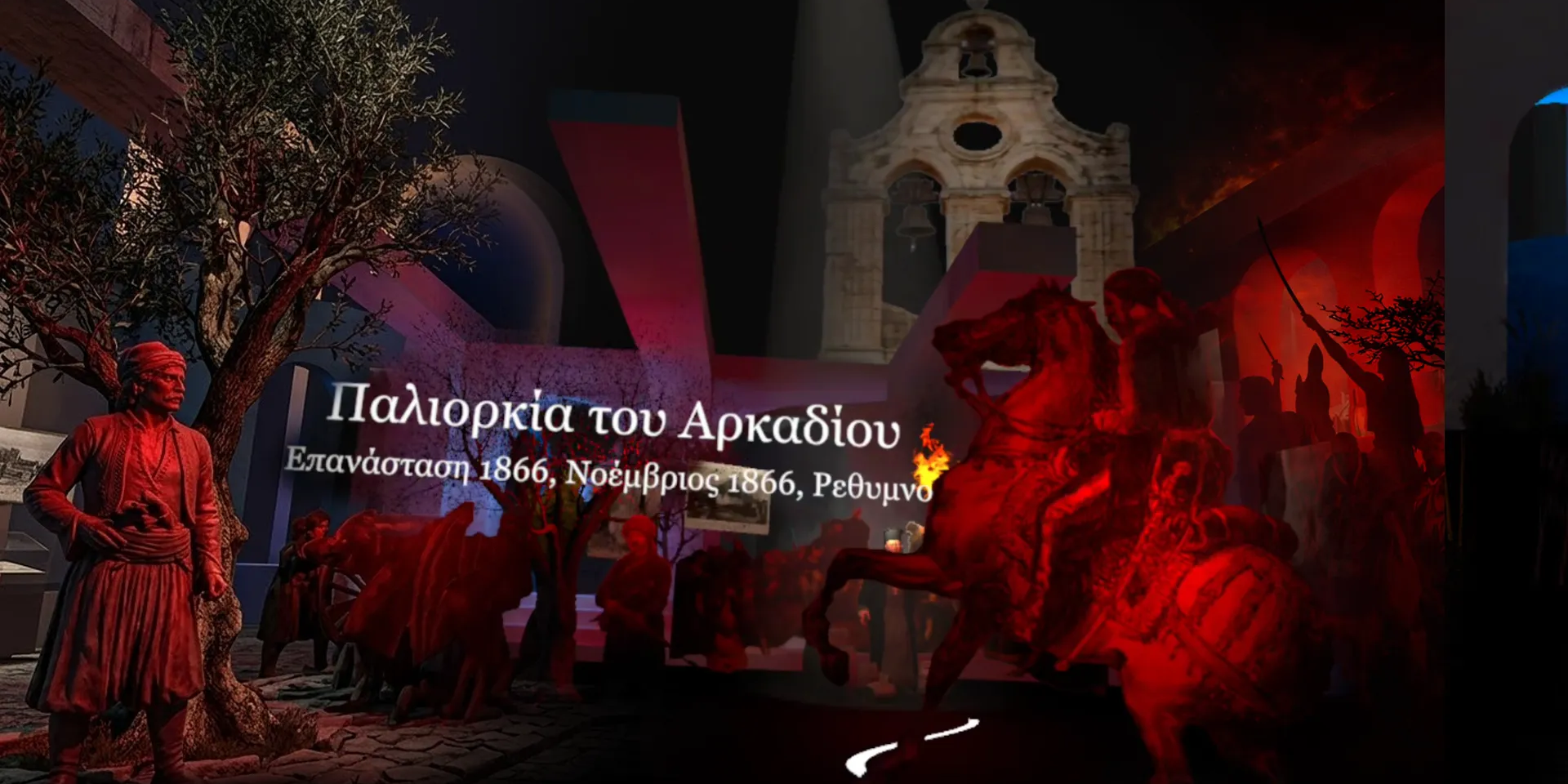
Bringing Cretan History Into VR
Fourthedesign developed an immersive cultural-heritage experience inspired by key moments of modern Cretan history. The application contains different historical scenes with custom 3D characters, narration, interactive navigation and a theatrical visual style that combines historical photo cut-outs, collage techniques, lighting and spatial sound.
The visitor begins in a central introductory scene and can choose which historical environment to explore. Inside each scene, characters connected to the event become part of the storytelling, making the experience feel more personal than a conventional information panel.
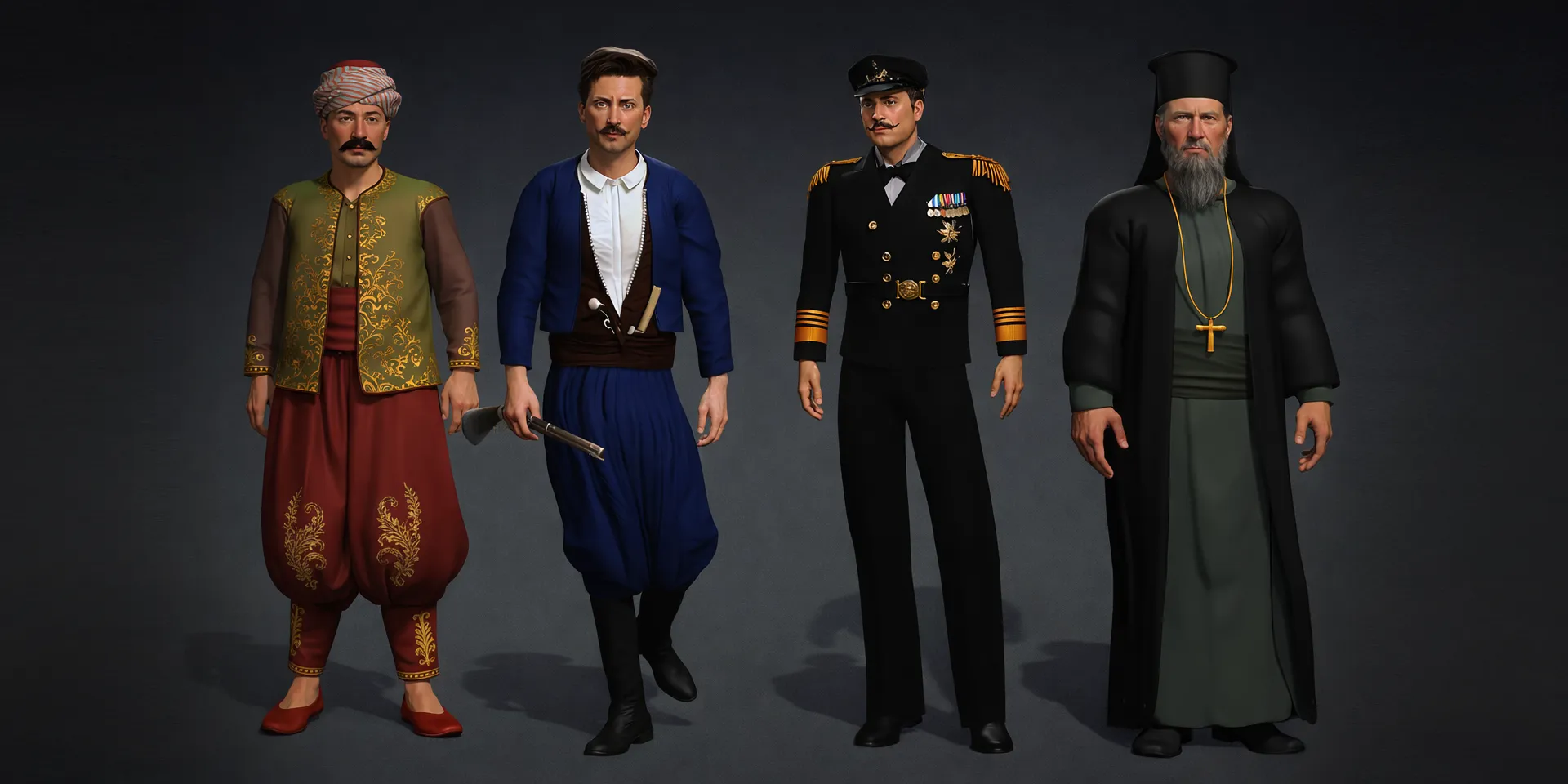
For museums, VR does not need to replace the physical exhibition. The strongest installations combine layers: authentic artifacts provide physical connection, text provides context, video provides narrative, and VR adds presence and spatial exploration.
View the VR Cultural Heritage Greece project →
VR Applications for Education
Education overlaps with almost every VR category. A student can explore a scientific process, examine machinery, enter a historical reconstruction, walk through an architectural environment or practise a medical procedure. The important difference is that the student is not only receiving information. They are interacting with it.
VR is especially useful when the subject involves three-dimensional relationships or when access to the real environment is limited. It can also support repeated practice without requiring travel, specialist facilities or constant access to physical equipment.
That does not mean every lesson should become a VR experience. The technology is most effective when immersion adds something that a book, video or browser-based application cannot provide as clearly or safely.
Standalone VR and Meta Quest Development
Standalone headsets are one of the main reasons professional VR has become easier to deploy. A device such as Meta Quest contains the processor, displays, tracking system and controllers in one portable package. For many business applications there is no need for a separate high-end computer.
This is useful for exhibitions, museums, training centers, sales teams and educational facilities. A headset can be configured with the application and transported directly to where it is needed.
However, standalone hardware has considerably less graphics power than a high-end workstation. Good Meta Quest development therefore requires careful optimization of 3D geometry, textures, materials, lighting, shaders, shadows, animation, memory use and draw calls.
The goal is not simply to make a scene look good in a desktop editor. It has to look good while maintaining the stable real-time performance required for a comfortable headset experience.
Unity VR Development
Professional applications are often built using real-time engines such as Unity. The engine provides the foundation for rendering, interaction, physics, animation, audio, UI and headset deployment, but a complete business application normally requires much more.
Depending on the project, developers may build custom systems for hand or controller interaction, teleportation, user guidance, scoring, multilingual interfaces, data logging, analytics, cloud services, APIs, administration tools or multiplayer functionality.
This is why it is useful to think of VR as software development inside a 3D environment. The visuals are what the user sees, but the application logic is what makes the experience useful.
How Is a Professional VR Application Developed?
A strong VR project normally starts long before anyone puts on a headset. The first step is to define the objective. What should the user understand, practise or accomplish?
For an industrial application, the goal might be completing a technical procedure correctly. For real estate, it may be understanding a property. For cultural heritage, it may be experiencing a historical story. For healthcare, it could be understanding a biological mechanism or learning to interact with equipment.
A typical development workflow includes:
- Discovery and requirements: audience, objectives, environment, deployment and hardware.
- Experience design: user flow, interactions, storyboard and scenario structure.
- 3D production: environments, equipment, characters, materials and animation.
- Application development: interaction logic, UI, navigation, scoring and integrations.
- Optimization: performance tuning for the target headset or PC.
- Testing: comfort, usability, readability, interaction distance and scenario logic.
- Deployment: installation, device setup, updates and support.
Testing is particularly important in VR because something that feels perfectly normal on a desktop monitor can feel awkward inside a headset. Movement speed, text size, button placement, interaction distance and camera behavior all affect comfort.
For larger projects, a prototype is often the smartest first milestone. It can validate the core interaction and user flow before the team invests time in final-quality environments, characters and visual effects.
How Much Does a VR Application Cost in Greece?
There is no single price for a professional VR application. Asking how much VR costs is a little like asking how much a building costs. A small apartment and a hospital are both buildings, but their scope is completely different.
The cost of VR development depends on factors such as the number and size of environments, the quality and quantity of 3D assets, the amount of interaction, animation, simulation logic, hardware targets, multiplayer requirements, backend systems, language versions, data collection, integrations and expected project duration.
A focused guided experience using existing 3D assets can be relatively compact. A multi-module industrial training platform with custom machinery, scenario logic, scoring and digital-twin features is a different category of project.
A useful first brief should therefore explain the target users, the main objective, expected duration, required interactions, preferred hardware and where the application will be used. Once those points are clear, the project can be divided into realistic production stages and estimated properly.
How Long Does VR Development Take?
Development time follows the same logic. A single environment with limited interaction can be produced far faster than a multi-module training system. Projects requiring detailed 3D reconstruction, medical animation, custom characters, large architectural environments or complex software integration naturally need more production time.
For larger projects, separating the work into prototype, core development and final production stages makes the schedule easier to control. It also gives stakeholders something useful to test early instead of waiting until the end to discover that an interaction needs to change.
Can Existing CAD, BIM or 3D Models Be Used in VR?
Often, yes. Architectural CAD files, BIM data, engineering models and existing 3D assets can provide an excellent starting point. But they usually cannot simply be dropped into a headset.
Engineering models are created for accuracy, not real-time rendering. They may contain millions of polygons, hidden components, duplicated geometry or materials that are unsuitable for VR. The assets normally need to be cleaned, reorganized and optimized before they are ready for an immersive application.
For architectural VR this may involve rebuilding materials, lighting and geometry. For industrial simulations it may involve preserving important machine components while removing unnecessary detail. The objective is to keep the information the user needs without wasting performance on geometry they will never see.
Can VR Applications Work Without an Internet Connection?
Yes. Many professional applications can run completely offline, which is useful for exhibitions, museums, industrial facilities and locations with unreliable internet access. The application can be installed directly on the headset and launched locally.
Internet access becomes useful when the application needs cloud analytics, live databases, remote content updates, user accounts, CRM data, multiplayer services or other connected functionality. The right architecture depends on what the project needs to accomplish.
Can Multiple VR Headsets Run the Same Application?
Yes. Applications can be deployed across multiple headsets. At an exhibition, for example, several visitors can use separate devices at the same time. In a training center, the same module can be installed on a fleet of headsets.
The devices can operate independently, or the application can be designed as a shared multiplayer environment. It is also possible to mirror the headset view to external screens so instructors, visitors or sales teams can follow what the user is seeing.
Choosing a VR Development Company in Greece
A professional VR project requires several disciplines to work together. Strong 3D graphics are important, but graphics alone do not create a useful application. Software development alone is not enough either. The strongest projects combine visual production, interaction design, real-time optimization, user experience and technical deployment.
When evaluating a VR development company in Greece, look for real experience in areas such as real-time 3D, Unity or Unreal development, headset optimization, immersive UX, 3D animation, custom interaction systems and final deployment.
Real delivered projects are especially important. A VR demo built only for a portfolio is different from an application that has been used at a museum, conference, sales presentation, university or industrial training facility.
Fourthedesign: Custom VR Applications in Greece
Fourthedesign is an immersive technology and 3D visualization studio based in Heraklion, Crete, Greece. We develop custom VR, AR and interactive 3D experiences for organizations in Greece and internationally.
Our work covers industrial training, medical and pharmaceutical visualization, architecture, real estate, museums, cultural heritage, education, interactive exhibitions and other fields where spatial communication can make information easier to understand.
The common element is not the industry. It is the need to communicate something through space and interaction.
Sometimes that means putting a trainee inside a virtual industrial facility. Sometimes it means shrinking a medical professional down to microscopic scale. Sometimes it means reconstructing a moment in history. Sometimes it means placing an entire future neighborhood inside a Meta Quest 3 headset.
Different problem. Same idea: make information something people can experience.
Explore more Fourthedesign VR & AR projects →
Frequently Asked Questions About VR Applications in Greece
What types of VR applications can Fourthedesign develop?
Fourthedesign develops custom virtual reality applications including industrial training simulations, health-and-safety training, medical VR, pharmaceutical visualization, architectural walkthroughs, real-estate experiences, cultural-heritage applications, museum experiences, educational VR and interactive corporate presentations.
Which VR headsets can professional applications use?
The choice depends on the project. Standalone platforms such as Meta Quest are useful for portable experiences, exhibitions and scalable deployment. PC-based VR may be more appropriate where very high visual fidelity or additional processing power is required.
Can Fourthedesign create a Meta Quest application?
Yes. Applications can be developed specifically for standalone Meta Quest hardware and optimized for the performance requirements of the headset.
Do we need existing 3D models?
No. A project can start from CAD, BIM, existing 3D assets, drawings, photographs, architectural plans or other reference material. Required assets can also be modeled specifically for the application.
Can a VR training application evaluate the user?
Yes. Depending on the project, a training system can record completed steps, mistakes, scores, decisions, time or other performance information.
Can VR applications be multilingual?
Yes. Interfaces, instructions, narration, subtitles and training content can be prepared in multiple languages.
Can a VR application work offline?
Yes. Many standalone applications can run without an internet connection when live data, cloud analytics or online services are not required.
Is VR only useful for large companies?
No. The important question is whether immersion solves a real problem. A focused museum experience, training module or property walkthrough can create value without becoming a large enterprise software project.
Can VR be used at exhibitions?
Yes. Standalone headsets are particularly practical for exhibitions because they can deliver interactive product demonstrations, property presentations, training scenarios or branded experiences without large computer installations.
How do we start a VR project?
Start with a short brief describing the audience, objective, environment, actions users should perform, preferred hardware and where the application will be used. From there, the appropriate technical approach, prototype and production scope can be defined.
Ready to Develop a VR Application in Greece?
Virtual reality works best when there is a real reason to enter the virtual world. Training can become safer. Buildings can be visited before they exist. Medical processes can become visible. Historical environments can be experienced in a new way. Industrial procedures can be practised without interrupting the real facility.
If your organization is exploring VR applications in Greece, Fourthedesign can help define, design and develop the complete experience — from the initial concept and 3D content to interaction development, optimization and final deployment.

