



AR Museum Guide: How Digital Guides Transform Visits
AR Museum Guide: How Digital Augmented Reality Guides Transform the Visitor Experience
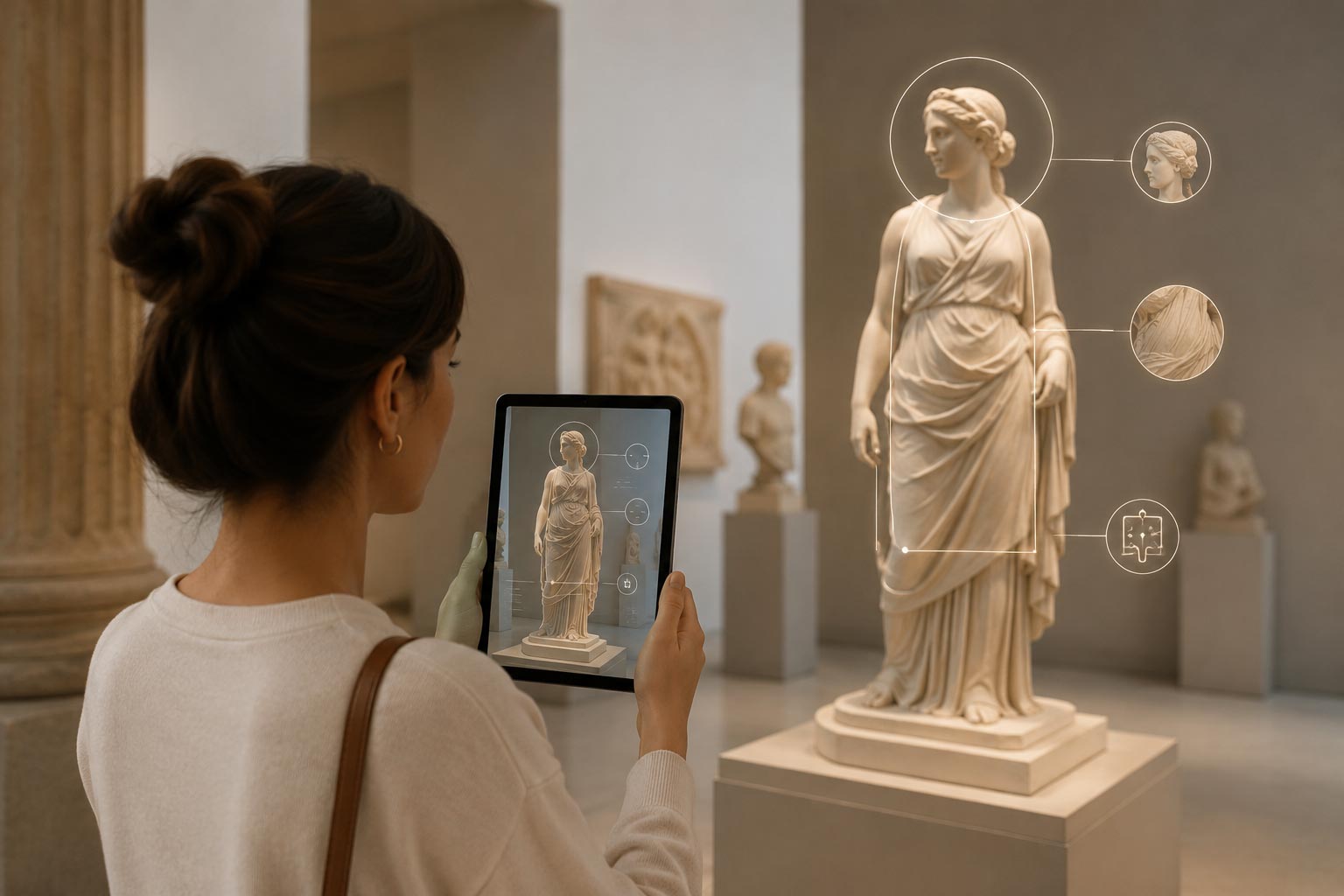
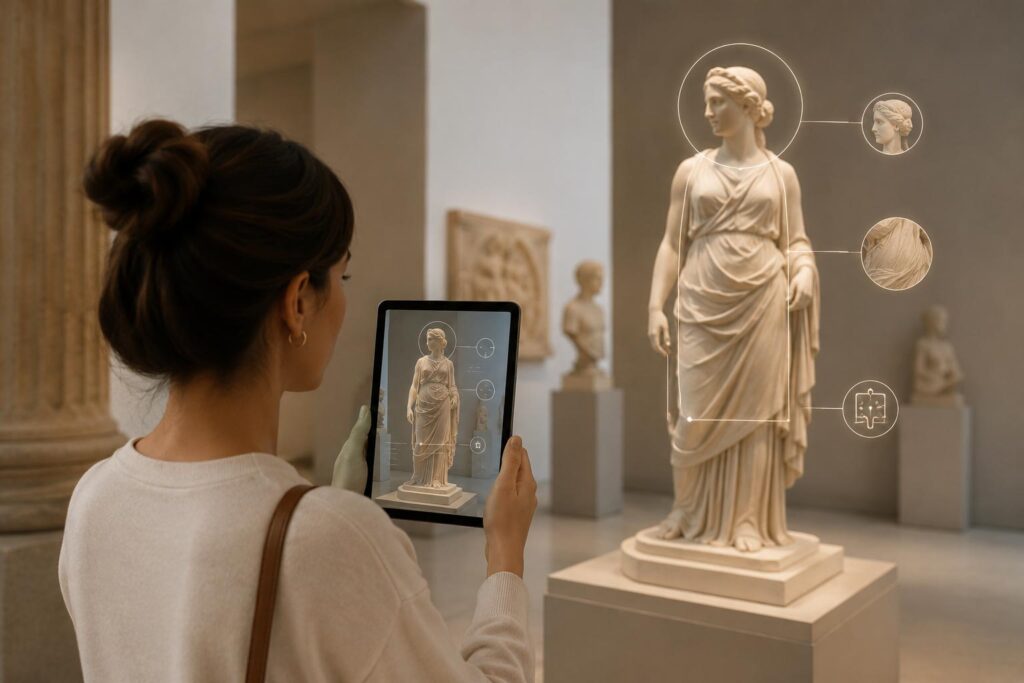
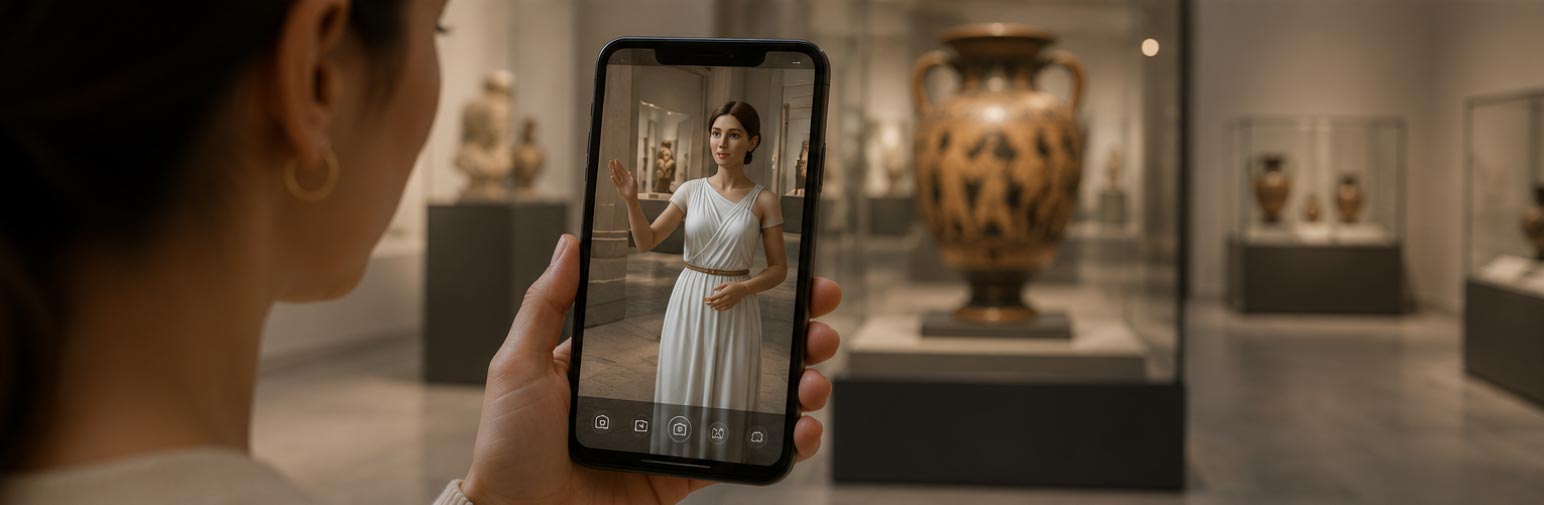
An AR museum guide overlays digital content directly onto physical exhibits — triggered by pointing a phone or tablet camera at an artifact, an installation, or a location marker in the museum space. The digital layer appears to emerge from or surround the physical object: animated explanations, historical context, comparative examples from other collections, reconstruction of missing or damaged elements, and narrative voices that speak from the object’s own perspective.
For museums seeking to increase visitor engagement, broaden accessibility across age groups and knowledge levels, and communicate the significance of their collections more effectively than conventional labels and printed guides allow, AR guides represent one of the most impactful technology investments available.

What an AR Museum Guide Actually Does
The most fundamental thing an AR museum guide does is collapse the cognitive distance between an artifact and its meaning. A fragment of ancient pottery in a glass case requires significant prior knowledge to understand as significant. The same fragment, viewed through an AR guide, can reveal: a reconstruction of the complete vessel it came from, a demonstration of how it was made, a scene of its original use in a domestic setting, comparative examples from similar finds, the archaeological context of its discovery, and the story of how it came to the collection.
This transformation from “object in case” to “object with meaning” is what increases dwell time — the time visitors spend with individual exhibits. Museum research consistently shows that visitors who engage with AR content spend 3–5 times longer with individual exhibits than visitors without digital tools. Longer dwell time correlates with stronger recall of the museum visit, higher visitor satisfaction ratings, higher likelihood of return visits, and higher likelihood of recommending the museum.
For children specifically, AR museum guides transform engagement dramatically. The combination of animation, interactive elements, and age-appropriate storytelling turns a visit that might be passive (trailing behind adults looking at things they don’t understand) into an active, exploratory experience.
AR Museum Guide Technical Approaches
AR museum guides are deployed using several technical architectures, with different implications for visitor experience and operational management.
Image recognition AR uses the physical exhibits or their labels as targets. The visitor points their phone camera at an object and the AR content triggers from the recognition of that specific image. This approach is highly precise — the AR content is exactly registered to the physical object — but requires the visitor to actively point their camera at specific targets, creating a more intentional engagement mode.
QR-code triggered AR is operationally simpler — visitors scan a QR code next to each exhibit to trigger the AR experience. Less immersive (the visitor must deliberately scan before experiencing) but very reliable and easy to update — content can be changed by updating the web destination without any app changes.
Location-based AR triggers content from GPS or Bluetooth beacon signals — as visitors move through different areas of the museum, content appears on their device. This approach creates a more ambient experience where content appears as visitors approach rather than requiring deliberate scanning, but the spatial precision of GPS indoors is limited.
The most sophisticated museum AR guides combine approaches: passive location-based context that provides orientation as visitors move through the museum, with image recognition triggers for specific objects that reward closer engagement.
Designing Effective AR Museum Content
The technology of an AR museum guide is ultimately in service of the content — and content design for museum AR has specific requirements that differ from other AR contexts.
Content must be stratified by depth. A visitor spending 30 seconds with an exhibit and a visitor spending 10 minutes should both get a satisfying experience. Short-form content (a 15-second animation of the object’s context) should be the primary experience that all visitors receive; longer-form content (a 3-minute narrative, a scholarly comparison, a full reconstruction tour) should be accessible to visitors who want to go deeper. Forcing all visitors through the same content length creates frustration for both the casual browser and the engaged learner.
Scientific and historical accuracy is non-negotiable in museum contexts. The museum’s curatorial credibility is associated with the AR content. Reconstruction of historical appearances, interpretations of archaeological function, and historical narrative must be validated by the museum’s academic and curatorial teams before deployment. AR content that contains errors is worse than no AR content — it actively replaces accurate understanding with inaccurate understanding.
Multiple languages are an operational requirement for most Greek museums. The combination of Greek-speaking domestic visitors and international visitors from dozens of language markets requires a multilingual content management system that allows the AR guide to serve each visitor in their preferred language.
Operational Considerations for AR Museum Guides
Deploying an AR museum guide involves operational decisions that extend beyond the technology itself.
Device strategy: Will the museum provide devices (tablets, smartphones), or will visitors use their own? Provided devices give more consistent experience control and are appropriate for visitor demographics who may not have compatible personal devices (older visitors, children). Visitor-owned devices are lower operational cost but require the experience to be delivered via a web application or installable app that visitors download.
Network infrastructure: Indoor AR requires reliable Wi-Fi throughout the museum space. Most museum Wi-Fi networks were not designed for high-density visitor usage simultaneously. Infrastructure assessment and upgrade is frequently a pre-condition for AR guide deployment.
Content management system: Museum content changes. New acquisitions arrive. Curatorial interpretations are updated. The AR guide needs a content management system that allows museum staff to update text, audio, and images without technical intervention from the development team.
Accessibility: AR guides should be designed for accessibility from the outset — audio descriptions for visitors with visual impairments, text alternatives for visitors with hearing impairments, simple interaction models for visitors with motor difficulties.
AR Museum Guide Cost Ranges
Basic QR-triggered AR guide for a single gallery (20 exhibits, 2 languages): €20,000–€45,000.
Image recognition AR guide for a full collection (100 exhibits, 4 languages, content management system): €60,000–€150,000.
Full-site AR experience with location-based and image recognition, provided devices: €100,000–€300,000.
CGI reconstruction of a major historical site or period for AR deployment: €50,000–€150,000 for the content production alone.
Our Museum AR Work
Fourthedesign has produced AR applications for the Heraklion Archaeological Museum — one of the most important collections of Minoan artefacts in the world. Our museum AR work combines precise historical reconstruction with accessible UX design.
See our museum AR project
Read about creating interactive content for exhibitions
