



Immersive Learning: How VR & AR Transforming Education & Training
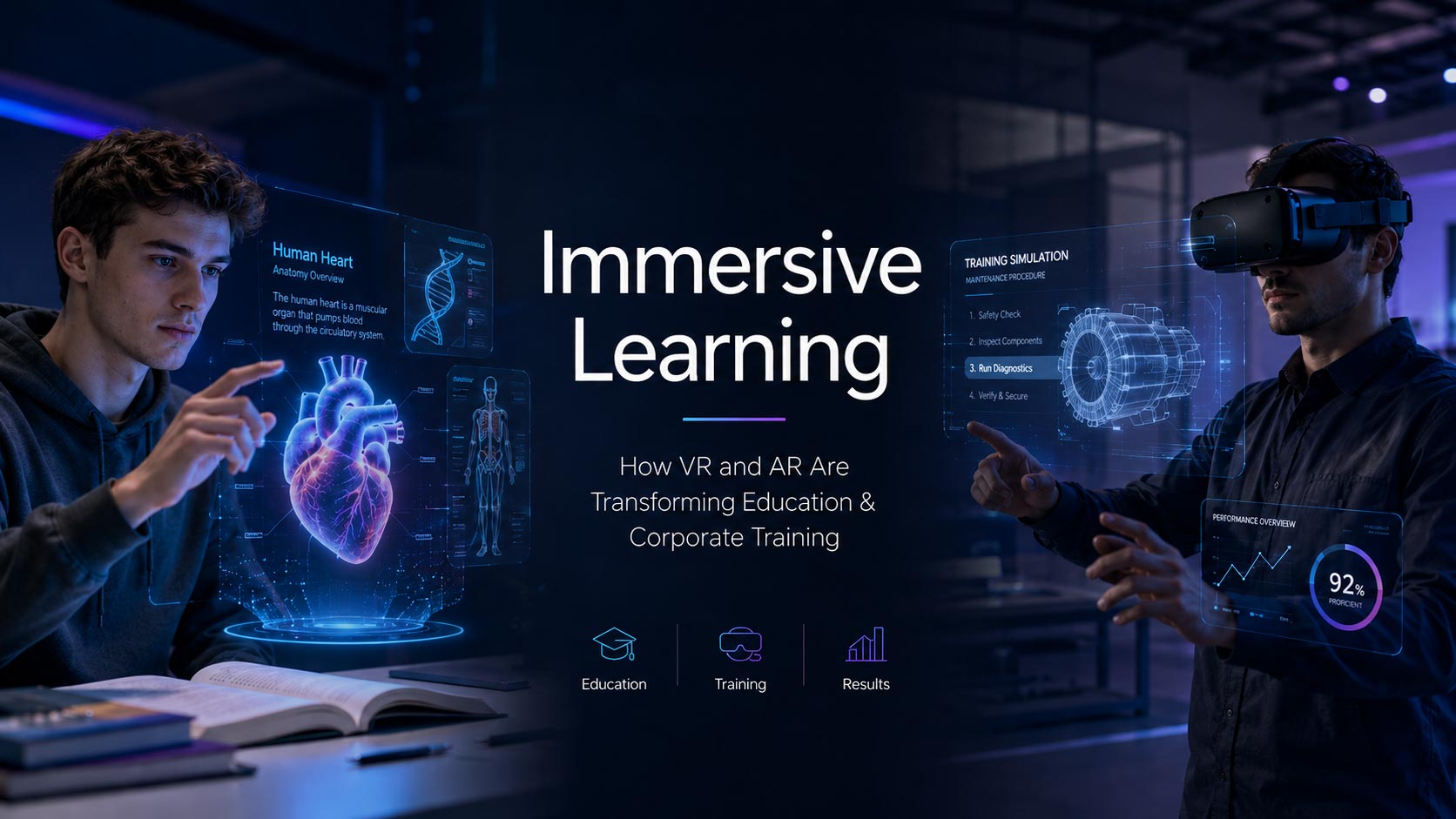 Immersive learning uses virtual and augmented reality to create educational experiences that engage learners at a depth conventional methods cannot match. When a medical student steps into a virtual operating theatre, when a chemical engineer walks through a simulated refinery incident, when a history student stands in ancient Athens as the Parthenon is built around them — these are not entertainment experiences. They are learning events that produce measurable improvements in knowledge retention, skill transfer, and learner confidence.
 The evidence base for immersive learning has matured significantly. This is not experimental technology anymore. It is a deployed educational methodology with peer-reviewed evidence behind it and a growing body of commercial implementation data.
The Evidence for Immersive Learning
The learning science behind immersive technology has moved well beyond theoretical framework into measured outcome data.
Retention improvement is the most consistently measured benefit. Learners in VR environments retain information at rates 3–4 times higher than those in conventional classroom settings, according to studies published in journals including Frontiers in Education and the Journal of Educational Technology Research. The mechanisms are well-understood: embodied cognition (learning through doing and experiencing rather than listening and reading), episodic memory encoding (experiences in 3D spatial environments encode differently and more durably than information received through 2D media), and emotional engagement (experiences that feel real generate the emotional arousal that enhances long-term memory formation).
PwC’s 2020 study of VR-based soft skills training across 10,000+ employees found that VR learners were 4x faster to train and 275% more confident in applying skills than classroom learners. For organizations training large populations on complex interpersonal skills — safety leadership, conflict resolution, patient communication — these are operationally significant numbers.
For procedural training specifically — where the goal is developing physical and cognitive routines rather than understanding concepts — immersive simulation has shown particularly strong results. The training transfer advantage (the degree to which training performance predicts real-world performance) of VR simulation exceeds that of traditional training by 40–60% in industrial and healthcare settings.
Immersive Learning Formats and Their Applications
Immersive learning is not one technology — it is a family of approaches, each suited to different educational objectives.
VR simulation places the learner in a fully immersive 3D environment where they practice procedures, make decisions, and experience consequences without real-world risk. This is the most powerful format for hazardous procedures (safety training, surgical training, emergency response), emotionally challenging scenarios (conflict resolution, patient communication, difficult conversations), and complex procedural sequences (aircraft maintenance, manufacturing assembly, medical procedures).
AR-enhanced learning overlays digital information, instructions, or contextual content on the learner’s real environment. A maintenance technician in AR sees step-by-step instructions overlaid on the actual piece of equipment they are servicing. A student studying anatomy in AR sees digital dissection layers overlaid on a printed textbook. A trainee chef in AR sees the ideal knife technique demonstrated on their actual cutting board.
Mixed reality collaborative environments allow multiple learners to share a virtual space from different physical locations — working together on a virtual project, examining a shared digital model, or practising team responses to simulated emergencies. This format is emerging as a powerful tool for distributed team training.
Immersive 360-degree experiences are used for awareness training and empathy development — experiencing environments from different perspectives, understanding conditions that are difficult to access physically, building contextual awareness of environments learners will work in.
Immersive Learning in Corporate Training
Corporate training is currently the largest deployment domain for immersive learning technology. The economic drivers are clear: large populations of employees, training standardization requirements, measurable performance outcomes, and high cost of real-world training failures.
Safety training leads deployment. Manufacturing, construction, maritime, oil and gas, and utilities industries have all demonstrated that VR safety simulation reduces incident rates and improves compliance versus conventional safety training. The combination of risk-free practice and high emotional engagement produces training transfer that lecture and video cannot match.
Soft skills and leadership training is the fastest-growing corporate immersive learning category. VR environments that simulate difficult performance conversations, inclusive leadership situations, or customer conflict scenarios allow managers to practise skills that are genuinely difficult to develop in safe contexts. The experience of virtually conducting a redundancy conversation or navigating a discrimination complaint creates preparation that role-play exercises with colleagues cannot.
Compliance training has traditionally been the most hated corporate learning format — mandatory, tedious, and forgotten immediately. Immersive compliance training that puts learners in the actual scenario they need to understand (what it feels like to be on a vessel when fire procedures are not followed correctly) produces compliance retention that annual online modules never achieve.
Building Immersive Learning Content: The Production Approach
Immersive learning content requires a production approach that integrates learning design with 3D and interactive development — a combination that most conventional e-learning studios and most 3D studios lack individually.
Learning design comes first. Before any 3D or VR work begins, the learning objectives must be specified: what will learners be able to do (not just know) after this experience? The assessment criteria must be defined. The decision moments — where the learner’s choices produce consequences — must be mapped. This phase is as important as any technical production phase.
3D environment production creates the world the learner inhabits — accurately representing the real-world environment where the learning transfer will occur. A maintenance training VR experience that uses a generic factory environment rather than a model of the actual facility the trainee will work in produces weaker transfer.
Interaction design defines how learners act within the environment — which objects they can interact with, what feedback they receive from actions, how the scenario branches based on choices, and how performance is measured and reported.
Iteration and testing with actual learners is essential before deployment. Immersive learning experiences that have not been tested with representative learners often have usability issues that significantly reduce effectiveness — confusing interaction models, inadequate feedback, or scenarios that are too easy or too difficult.
Implementation and Cost
Single-scenario immersive learning module (VR or AR, one training objective): €10,000–€30,000.
Corporate training platform with multiple scenarios: €30,000–€60,000.
AR-assisted performance support application (field service, maintenance): €10,000–€30,000.
Timeline: 12–24 weeks for single-scenario development including learning design, 3D production, interaction development, testing, and deployment.
Our Immersive Learning and Training Work
Fourthedesign produces VR and interactive simulations for professional training across maritime, industrial, and healthcare sectors. Our ship collision simulator demonstrates the technical depth we apply to training environments.
