



VR Training for Manufacturing | Industrial VR & Digital Twins
VR Training for Manufacturing: How Immersive Training Is Changing Industrial Workforce Development
Manufacturing environments are becoming more complex. Machines are more advanced, production processes are increasingly automated, safety requirements are higher, and companies need to train employees faster without constantly interrupting real operations.
This is where VR training for manufacturing is becoming particularly valuable.
Virtual Reality allows employees to enter a realistic digital version of a factory, production line, machine or work environment and practise procedures without affecting the real workplace. Instead of only watching a training video or reading instructions, employees can perform the procedure themselves.
They can move around equipment, use tools, follow maintenance steps, identify hazards, respond to unexpected situations and even make mistakes without damaging equipment or putting themselves or others at risk.
For industrial companies, that changes training from something employees simply watch into something they actually experience.

What Is VR Training for Manufacturing?
VR training for manufacturing is the use of interactive Virtual Reality simulations to teach employees industrial procedures, machinery operation, maintenance, safety and other workplace skills.
At Fourthedesign, our Virtual Reality development work focuses on creating interactive environments where users can learn by doing rather than simply watching.
Depending on the application, trainees may need to:
- operate machinery
- follow assembly procedures
- perform maintenance tasks
- identify safety hazards
- dismantle equipment
- respond to emergencies
- inspect components
- select the correct tools
- learn production workflows
- follow step-by-step instructions
The virtual environment can reproduce an existing factory or machine, or it can represent a facility that is still being designed.
This is useful because an employee does not need access to the actual production equipment every time training takes place. A machine costing hundreds of thousands of euros does not need to stop production simply because somebody needs to learn how it works.
Why Traditional Industrial Training Has Limitations
Traditional training will always have an important role in manufacturing, but it also has practical limitations.
Imagine that a new employee needs to learn a complex maintenance procedure. The company may need an experienced technician to stop their normal work, supervise the trainee and provide access to the real machine.
In some cases, the equipment must be taken out of production. In others, the training situation may be difficult or dangerous to reproduce.
A fire, mechanical failure, hazardous material incident, incorrect shutdown procedure or emergency evacuation should obviously not be created in the real world just so somebody can practise it.
With an industrial VR training and Digital Twin simulation, these situations can be recreated inside a controlled virtual environment.
The employee can experience the consequences of their decisions while remaining safe.
And when something goes wrong, the simulation can simply restart. Much easier than restarting a factory.
1. VR Safety Training
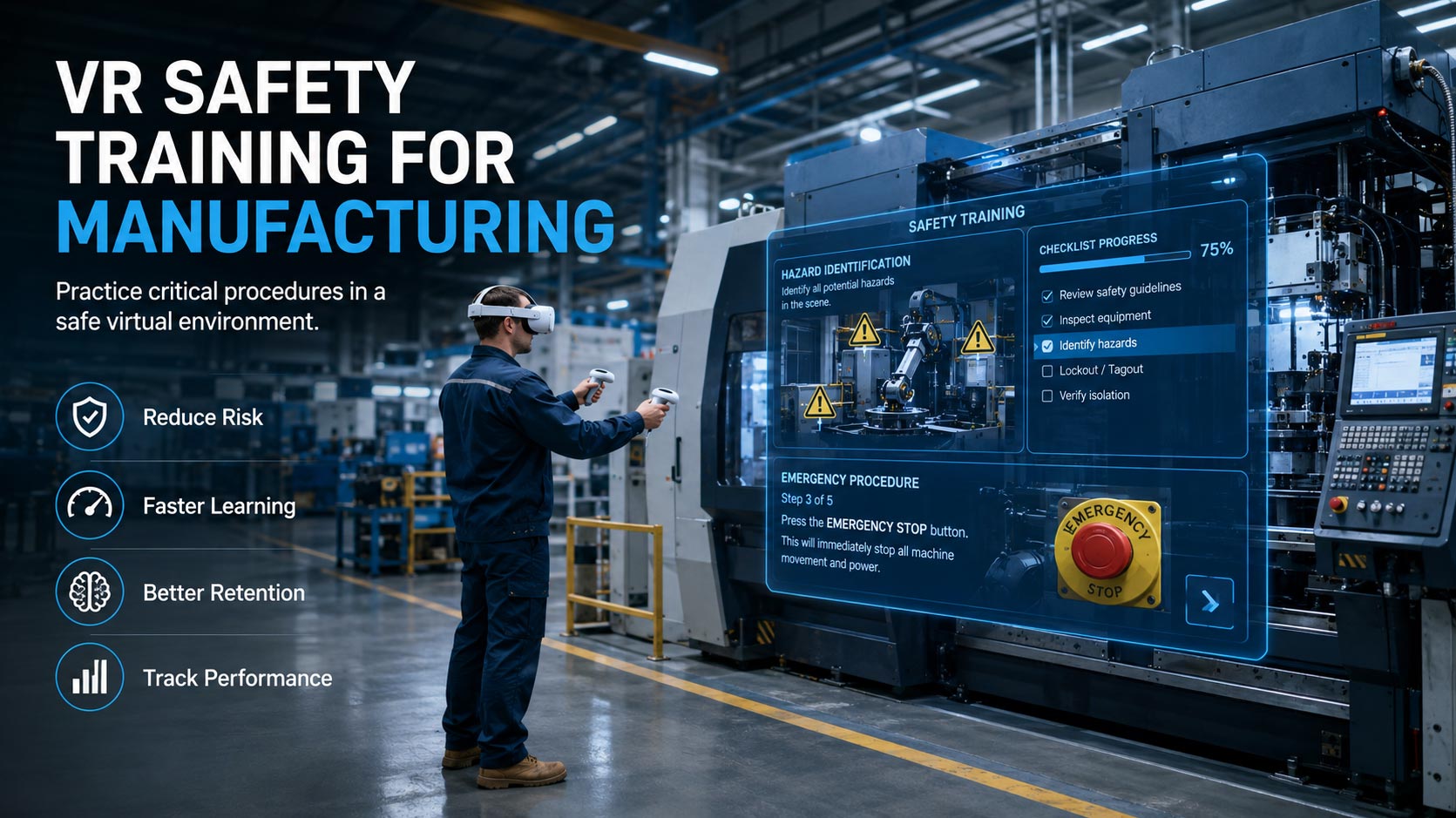
Safety is one of the strongest applications of Virtual Reality in industry.
Traditional safety training often explains what employees should do. VR can ask them to actually do it.
For example, a trainee may enter a virtual production area and need to identify potential hazards such as an improperly positioned object, missing personal protective equipment, a dangerous machine state, an unsafe access point or a blocked emergency exit.
Instead of simply being told where the danger is, the employee has to recognise it.
VR safety training can also recreate situations that would be dangerous or expensive to simulate physically, including:
- fires
- equipment failures
- electrical hazards
- chemical incidents
- confined spaces
- emergency shutdowns
- evacuation procedures
- dangerous machinery operations
Employees can repeat these scenarios until the correct response becomes familiar.
2. Machine and Equipment Training
Learning how to operate industrial equipment often requires access to the real machine. That creates several challenges.
The equipment may be expensive, it may already be operating continuously, its availability for training may be limited, and inexperienced employees may accidentally damage it.
A VR training simulation can recreate the machine digitally.
The trainee can learn where controls are located, understand the operating sequence and practise procedures before interacting with the real equipment.
The simulation can guide the employee through every step:
- Step 1: Select the correct tool.
- Step 2: Identify the correct component.
- Step 3: Follow the required safety procedure.
- Step 4: Perform the operation.
- Step 5: Confirm that the task has been completed correctly.
As the trainee becomes more experienced, guidance can gradually be reduced until the complete procedure can be performed without assistance.
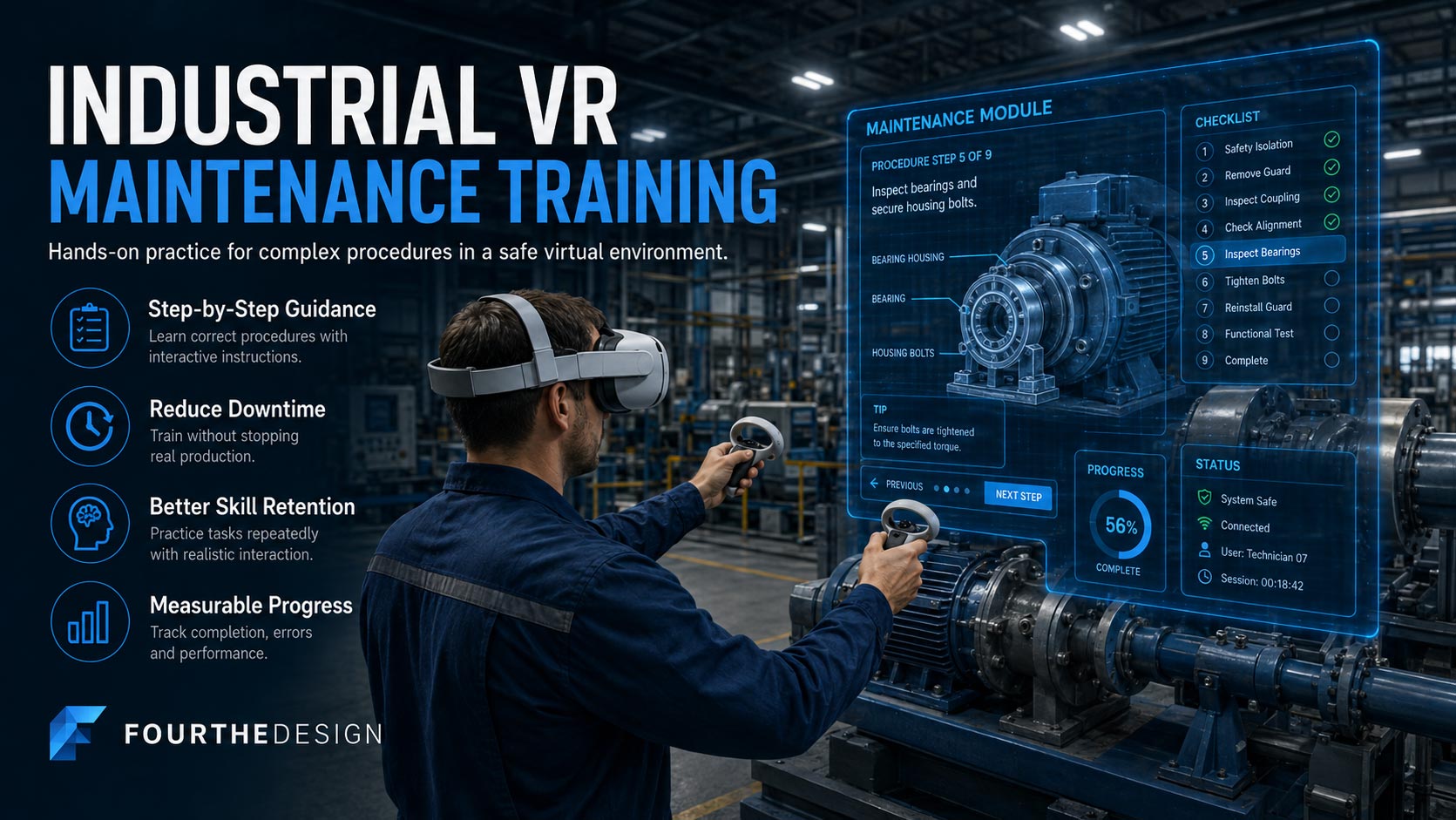
3. Maintenance and Repair Training
Maintenance technicians often need to understand complicated sequences involving many components.
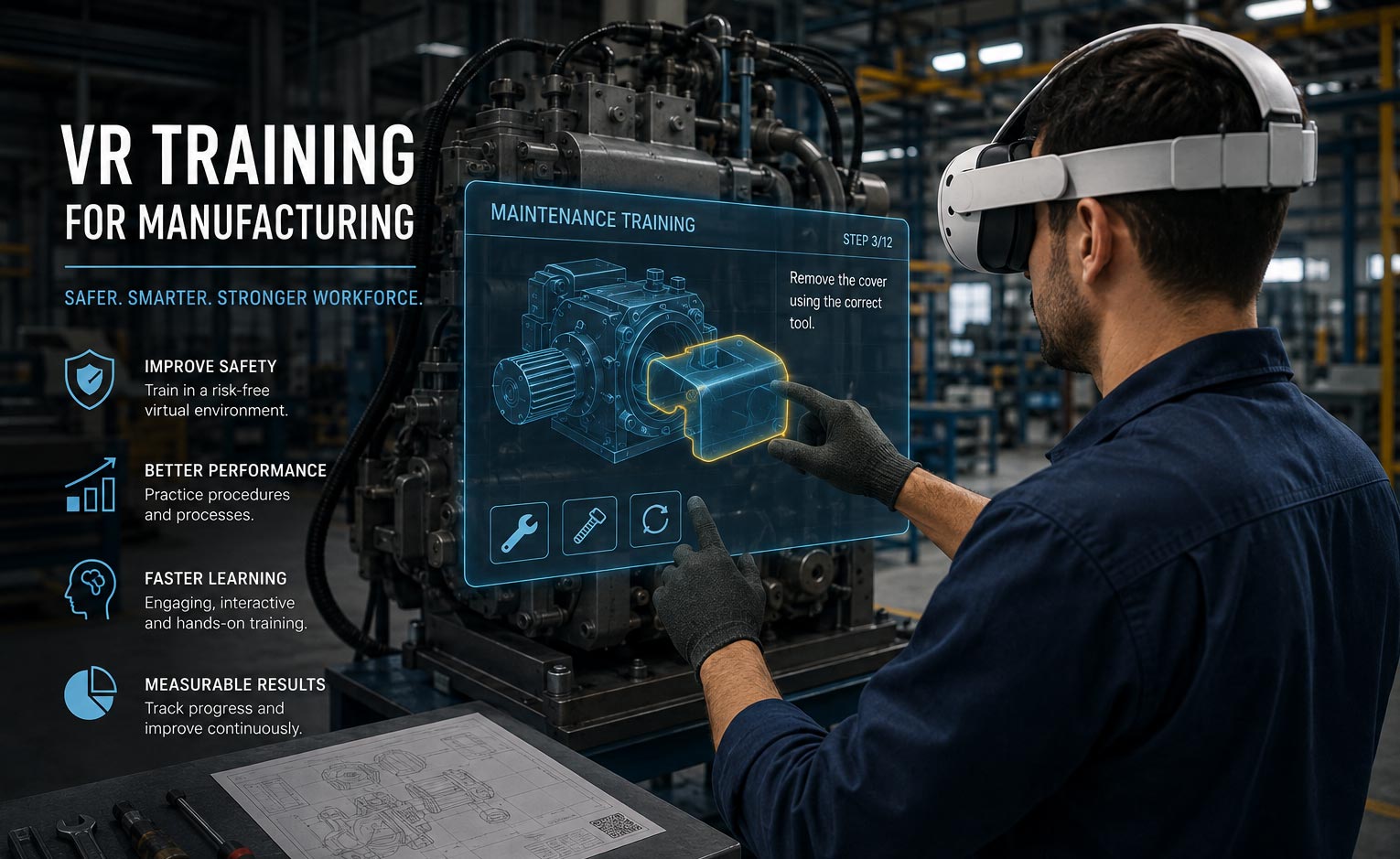
VR can make these procedures easier to understand by allowing a trainee to virtually open a machine, remove components, inspect parts and see information directly next to the relevant equipment.
Instead of constantly moving between a machine and a manual, the training information can become part of the environment itself.
The system can display:
- component names
- maintenance instructions
- tool requirements
- safety warnings
- technical information
- the correct sequence of operations
This approach can also be combined with Augmented Reality training solutions when guidance needs to appear over the real machine instead of inside a fully virtual environment.
4. Assembly and Production Training
Assembly processes often depend heavily on sequence. One incorrect step can create problems further down the production line.
VR manufacturing training can recreate an assembly process and allow employees to practise until the workflow becomes familiar.
The system can detect whether the trainee selected the correct component, used the correct tool or completed an operation in the correct order.
It can also provide feedback immediately when a mistake happens instead of waiting until the end of the session.
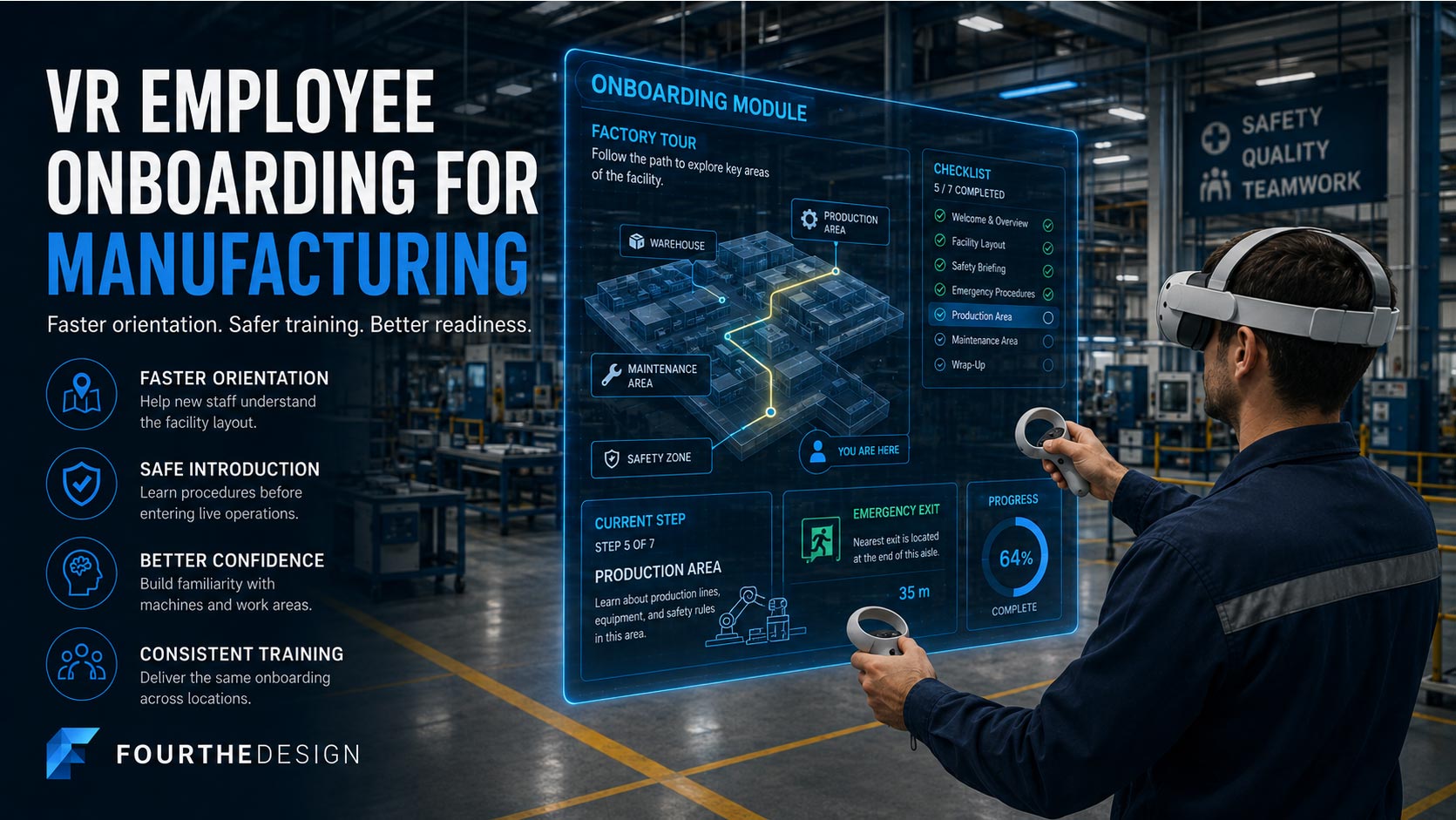
5. Employee Onboarding
One of the most practical uses of immersive training is employee onboarding.
A new employee can explore a virtual version of a facility before entering the real production environment.
They can learn:
- where departments are located
- how production is organised
- which areas are restricted
- where safety equipment is located
- how emergency procedures work
- how to interact with specific machinery
For broader learning programmes, Virtual Reality can become part of an organisation’s immersive education and eLearning strategy, combining simulation, assessment and interactive learning.
6. Training Without Interrupting Production
Manufacturing companies cannot stop production every time training is required.
This is one of the practical advantages of VR.
Employees can train on a virtual machine while the real machine continues operating. Training can also happen at another location entirely.
A company with facilities in different cities or countries can deploy the same training application across multiple sites, helping create a more consistent learning process.
Everyone can experience the same scenarios, instructions and assessment criteria.
VR Training Can Measure Performance
One major difference between traditional training and digital training is data.
A VR application does not only show content. It can record what happens.
For example, the system can measure:
- completion time
- number of errors
- incorrect actions
- correct procedure sequence
- reaction time
- tools selected
- safety violations
- skipped steps
- number of attempts
- final score
This information can help trainers understand where employees are struggling.
Example: If a large percentage of trainees repeatedly make the same mistake during a maintenance step, the problem may not only be the trainee. It could also reveal that the procedure or instructions themselves need improvement.
In this way, VR training can provide useful information for employees, trainers, managers and process designers.
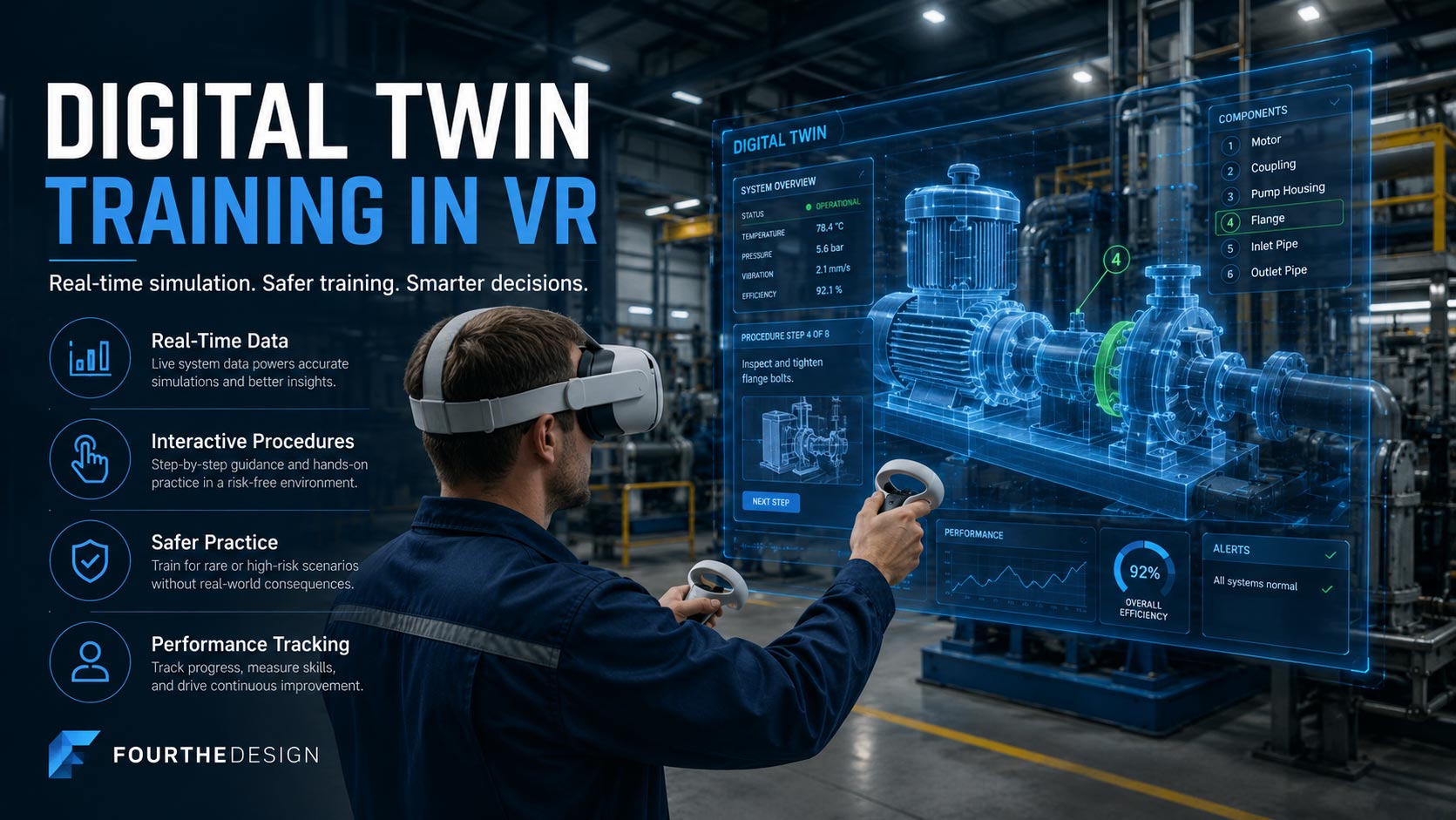
VR Training and Digital Twins
Things become even more interesting when Virtual Reality is connected with Digital Twin technology.
A traditional VR environment may represent a machine or facility. A Digital Twin can connect the digital environment with information related to the real system.
That information can include:
- machine status
- equipment configuration
- sensor information
- production data
- maintenance information
- operational conditions
- material flows
- efficiency indicators
Fourthedesign is already applying this approach in its VR Training and Digital Twins for industry work, where immersive training scenarios are combined with interactive industrial simulations and Digital Twin visualisation.
Instead of building a completely isolated training application, organisations can begin using digital representations of real assets for several purposes.
The same environment can potentially support training, maintenance planning, visualisation, remote collaboration and operational analysis.
A Real Industrial VR Training Example
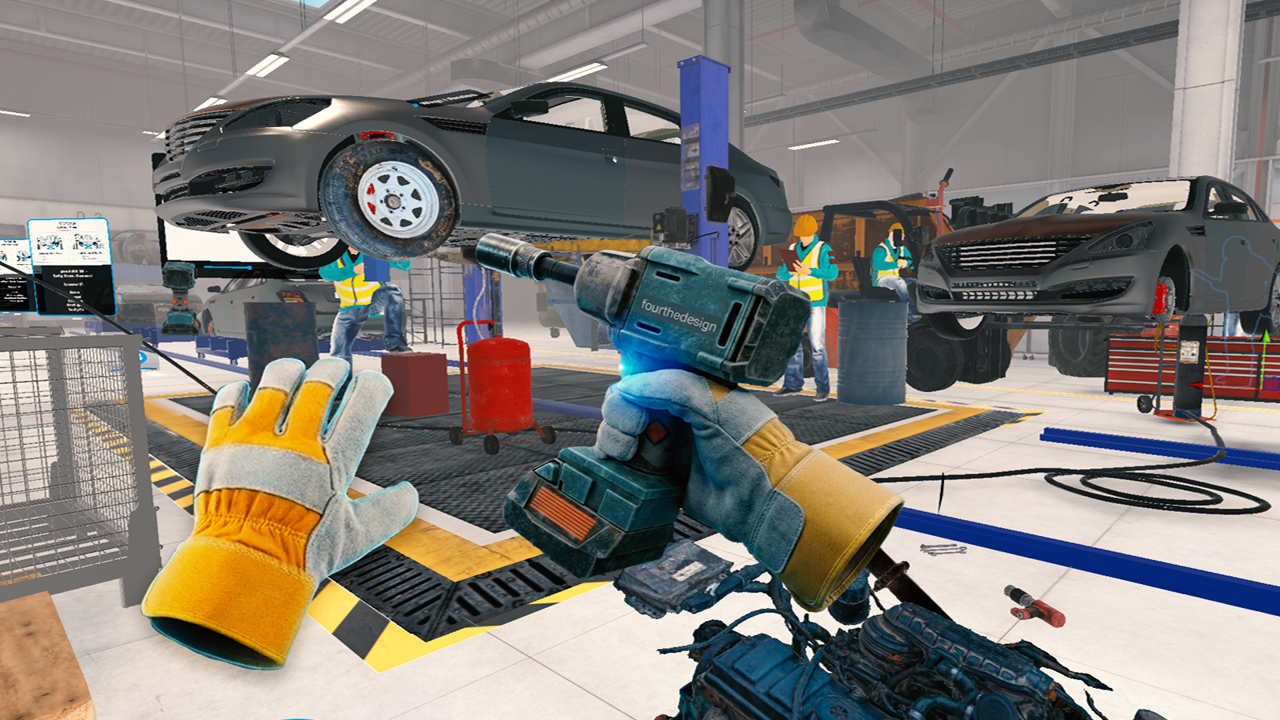
One example is Fourthedesign’s work within the C-MineTech project, where we participate as the immersive technology partner.
The project uses real-time VR training environments, interactive industrial simulations, Digital Twin visualisation and scenario-based learning for the raw materials and automotive recycling sector.
The immersive training scenarios cover processes such as dismantling, sorting, recovery and safety, while Digital Twin elements help visualise information connected with material flow, efficiency and environmental impact.
You can explore the project in the industrial VR training case study.
AI Could Make VR Training Adaptive
Most digital training experiences still follow a predefined sequence.
The trainee completes Step A, then Step B, then Step C.
AI opens the possibility of making that training more dynamic.
Imagine an AI assistant inside the VR environment. An employee could ask why a particular component must be disconnected first and receive contextual guidance while remaining inside the simulation.
If the trainee repeatedly struggles with one task, the system could provide additional guidance automatically.
More advanced applications could adjust difficulty depending on performance.
A beginner might receive detailed visual instructions. An experienced employee might receive almost no guidance. Another trainee might be given unexpected situations designed to test decision-making.
The training experience starts adapting to the user rather than forcing every user through exactly the same path.
Real-Time 3D Makes Industrial Training Interactive
Creating an industrial VR application is very different from creating a conventional animation.
An animation plays. A VR application reacts.
The user can move, interact with objects, make choices, perform operations and change what happens next.
This is why strong 3D visualisation and animation is only one part of an industrial VR project. The environment also needs real-time logic, interaction design, user feedback and training rules.
The result is not simply a visualisation of a factory.
It becomes an interactive simulation.
Standalone VR Headsets for Industrial Training
Standalone VR headsets have made immersive training easier to deploy.
Modern devices can operate without a dedicated high-end computer permanently connected by cable.
For many industrial training applications, this makes deployment much more practical.
A company can prepare multiple headsets and distribute them across training locations. Employees put on the headset, launch the application and begin the training session.
PC-based VR can still make sense when extremely high visual quality, very complex scenes or specialised hardware integration is required.
The right platform should be selected according to the training objective rather than simply choosing the most powerful hardware available.
How Much Does a Custom VR Training Application Cost?
This is usually one of the first questions companies ask.
There is no single price for a custom VR training application because the development effort depends heavily on the complexity of the simulation.
Important factors include:
- number of training scenarios
- complexity of the environment
- complexity of machinery
- number of interactive objects
- required visual realism
- animations
- user interface
- scoring and assessment
- data collection
- backend integration
- multiplayer functionality
- Digital Twin integration
- AI functionality
- target VR hardware
A focused training simulation covering one procedure is very different from recreating an entire production facility with multiple machines and training modules.
For this reason, a smart starting point is often to identify one specific training problem, develop the first module, test it with real employees, measure the results and then expand.
When Does VR Training Make the Most Sense?
Not every training procedure needs Virtual Reality.
Sometimes a video is enough. Sometimes a manual is enough. Sometimes physical training remains the best solution.
VR becomes particularly valuable when:
- the real equipment is expensive
- mistakes can be dangerous
- equipment availability is limited
- training interrupts production
- the environment is difficult to access
- procedures are complex
- employees need repeated practice
- multiple locations require consistent training
- companies want measurable training data
The important question is not: “Can we create this in VR?”
The better question is: “Will VR improve this particular training process?”

How Fourthedesign Approaches Industrial VR Training
At Fourthedesign, we develop interactive Real-Time 3D, Virtual Reality, Augmented Reality and Digital Twin applications for industrial, training and professional environments.
Our approach begins with the real procedure.
What does the employee need to learn? Which decisions matter? Which mistakes are important? Which tools and equipment need to be represented? What should be measured?
Only after answering these questions does development of the virtual environment begin.
Depending on the project, an industrial VR training application can include:
- realistic 3D environments
- interactive machinery
- virtual tools
- step-by-step guidance
- safety scenarios
- scoring systems
- performance analytics
- information panels
- virtual assistants
- Digital Twin data
- multiplayer training
- standalone VR deployment
- PC VR
- real-time 3D development
The goal is not simply to create an impressive VR demonstration.
The goal is to create a useful training tool.
The Future of Manufacturing Training Will Be More Immersive
Manufacturing training is moving toward a combination of technologies: Virtual Reality, Augmented Reality, Real-Time 3D, Digital Twins, Artificial Intelligence and data analytics.
Individually, each technology is useful. Together, they can create something much more powerful.
Imagine a new employee entering a virtual version of the factory. An AI assistant guides them through the environment. The machines behave like the real machines. The training scenario adapts to their performance. Mistakes are automatically recorded. The trainer can review the results.
The same digital environment may later support maintenance planning, remote assistance or operational visualisation.
At that point, VR is no longer just a training experience.
It becomes part of the company’s digital infrastructure.
And that is where VR training for manufacturing starts becoming much more interesting.
Frequently Asked Questions About VR Training for Manufacturing
Click a question to expand the answer.
What is VR training in manufacturing?
VR training in manufacturing uses interactive Virtual Reality environments to teach employees industrial procedures, machinery operation, maintenance, safety and other workplace skills. Trainees can practise tasks inside a controlled digital environment before performing them on real equipment.
What are the benefits of industrial VR training?
Industrial VR training can provide a safe environment for practice, reduce the need to use real production equipment during training, allow procedures to be repeated consistently and collect measurable information about trainee performance.
Can VR be used for safety training?
Yes. VR can recreate hazardous situations such as equipment failures, emergency procedures and workplace risks without exposing employees to real danger. This makes it particularly useful for scenarios that are difficult, expensive or unsafe to reproduce physically.
Can VR training simulate real machinery?
Yes. Machines and equipment can be recreated as interactive 3D models so employees can practise operating, maintaining, assembling or dismantling them. The level of simulation can range from procedural training to highly detailed interactive systems.
Can VR training connect with a Digital Twin?
Yes. A VR environment can be combined with Digital Twin systems and operational information to create more advanced training, monitoring and visualisation applications. See Fourthedesign’s industrial VR training and Digital Twin project for an example.
Can companies track employee performance in VR?
Yes. VR training applications can record information such as completion times, mistakes, skipped steps, reaction times, tool selection, sequence of actions and overall training scores.
How long does it take to develop a VR training application?
Development time depends on the complexity of the environment, machinery, interactions and training procedures. A focused single training module can be developed much faster than a complete virtual factory containing multiple machines and scenarios.
Is VR training suitable only for large companies?
No. VR can also be useful for smaller organisations when a training procedure is expensive, dangerous, repetitive, difficult to reproduce or requires consistent training across multiple employees.
What is the difference between VR training and AR training?
VR places the trainee inside a fully digital environment, while AR adds digital guidance and information to the real environment. Fourthedesign develops both VR development solutions and Augmented Reality solutions, depending on the training requirement.
Build Your Industrial VR Training Solution
If your organisation is exploring VR training for manufacturing, industrial simulations, Digital Twins or immersive workforce training, Fourthedesign can help evaluate the idea and develop the right solution.
Explore our Virtual Reality development services, view our industrial VR training and Digital Twin case study, or contact Fourthedesign to discuss a project.
The best place to start is one simple question:
What process would you like your employees to learn better, faster or more safely?
