



VR Real Estate Tours: Sell Property Before It’s Built
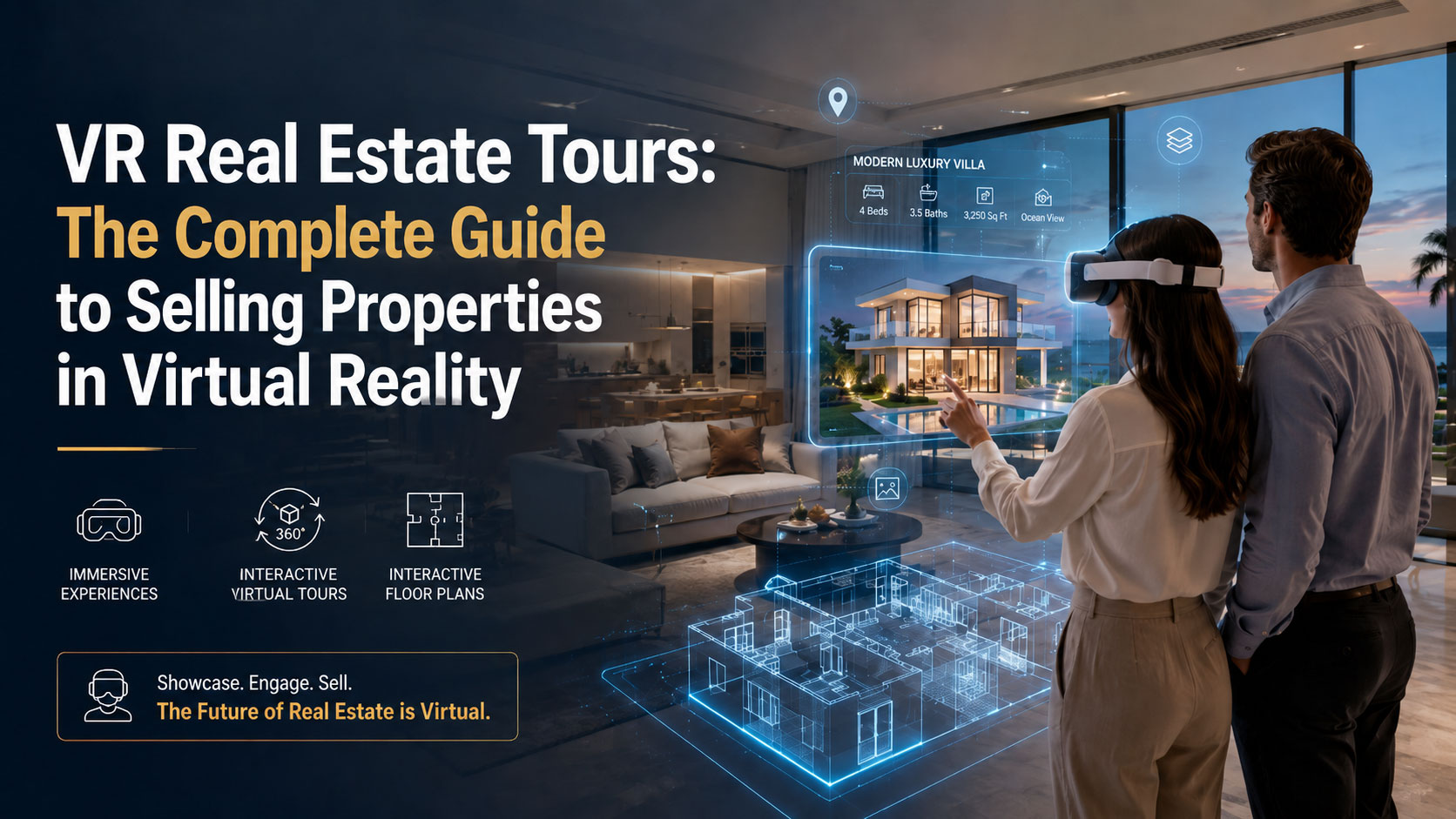
VR Real Estate Tours: The Complete Guide to Selling Properties in Virtual Reality
VR real estate tours have shifted from a novelty used by a handful of luxury developers to a mainstream sales tool expected by premium buyers across Europe. The reason is simple economics: when a developer can show a prospective buyer exactly what their apartment will look, feel, and live like — months before construction completes — conversion happens faster, at higher prices, and with significantly lower buyer hesitation.
Fourthedesign produces VR real estate tours for residential developers, hotel projects, and villa complexes across Greece and Europe. This guide explains how VR tours work, what production involves, what they cost, and — critically — where in the sales process they deliver the most value.

What a VR Real Estate Tour Delivers
A VR real estate tour is a three-dimensional, explorable representation of a property — built from architectural plans and design specifications before a single brick is laid. Using a VR headset, a prospective buyer can stand in the living room, walk to the window and look out at the view, open the kitchen and examine the island, step into the master bedroom and assess the proportions, and exit onto the terrace to feel the outdoor space.
This experience is fundamentally different from anything a floor plan, a render, or even an animated walkthrough can provide. The buyer is inside the space, making spatial judgments with their actual body — assessing ceiling height, natural light quality, room flow, and the relationship between spaces in the only way that actually captures these qualities accurately: from within them.
For off-plan sales — where the apartment literally does not yet exist — this difference translates directly into faster purchase decisions, higher pricing acceptance, and lower withdrawal rates after reservation.
VR Tour Formats: Which One Fits Your Project
VR real estate tours come in several technical formats, each appropriate to different sales contexts.
Headset VR experiences (Meta Quest, PSVR) provide the most immersive experience and are deployed at sales centres where developers can have buyers try the headset. The buyer is physically transported into the property — all other stimuli removed — and the spatial impression is the most accurate of any format. Suitable for premium residential, high-rise luxury apartments, and resort villas where buyers are coming to a dedicated sales environment.
Browser-based 3D tours are WebGL applications that run in any computer browser — the buyer uses their mouse or keyboard to navigate through the property. Lower immersion than headset VR but zero distribution friction: send a link by email and the buyer is inside the property in seconds, anywhere in the world. Essential for international buyers who cannot visit the sales centre.
Tablet AR tours let buyers hold a tablet or phone over a printed site plan and see the building emerge at scale in augmented reality. They can walk around the virtual building on the actual site, understanding the building’s relationship to its surroundings from ground level. Highly effective for on-site sales meetings.
The Production Process for VR Real Estate Tours
VR real estate tour production begins with the architectural data — the more complete, the better, but we can work at every stage of the design process.
Geometry preparation transforms architectural CAD data (Revit, ArchiCAD, AutoCAD) into real-time-ready 3D geometry. This phase involves cleaning and optimizing the architectural model, adding structural and detail elements that may not be present in schematic drawings, and creating the outdoor context — site landscaping, surrounding buildings, view corridors.
Interior dressing is where the property becomes a home rather than a shell. Furniture selection, material specification, lighting design, and accessory styling all contribute to a space that communicates lifestyle as effectively as it communicates architecture. This phase requires the closest collaboration with the developer’s interior concept — or, if no interior design has been specified, concept development from the developer’s target buyer profile.
Real-time optimization converts the fully dressed interior into a scene that renders at 90 frames per second in a VR headset — a requirement without which users experience motion sickness. This phase involves LOD (level of detail) management, baked lighting, texture compression, and draw call optimization. It is invisible to the end user but is the difference between a comfortable experience and an unusable one.
Interaction scripting defines what the user can do: walk freely, teleport between rooms, open doors, switch between material options, toggle between day and night lighting. The more interactions are included, the higher the production cost — but also the higher the engagement and the more useful the sales tool.
VR Real Estate Tour Cost Ranges
VR real estate tour costs reflect the scale and complexity of the property and the level of interactive functionality required.
A single apartment unit, standard specification, headset and browser delivery: €4,000–€6,000. The majority of this cost is in 3D production (geometry, materials, lighting) rather than software development, which is relatively standardized for this format.
A full apartment complex show home (one representative unit of each type), with material switching and day/night: €5,000–€10,000. Scaling across multiple unit types significantly increases the material and furnishing asset count.
A luxury villa or resort project with outdoor spaces, pool, and landscaping: €8,000–€15,000. Outdoor environments at resort quality are computationally complex and require more intensive optimization.
A complete development with multiple unit types, common areas, and site context: €13,000–€20,000. Full-development VR experiences are essentially real-time architecture software products.
Browser-based 3D tours without full VR headset support cost 30–50% less than headset VR equivalents, making them more accessible for smaller developers.
Where VR Tours Deliver the Highest ROI
The return on VR real estate tour investment is highest in specific circumstances that are worth understanding before committing to production.
Off-plan sales benefit most. When there is nothing physical to show a buyer, a VR tour is the primary sales tool, not a supplement. Developers who deploy VR tours at launch routinely close reservations 40–60% faster than developers relying on plans and mood boards.
International buyer markets are particularly valuable. Buyers who cannot visit a property in person — Greeks based abroad, Northern European buyers of holiday properties, international investors — make purchase decisions based on digital content alone. A VR tour that they can experience at home, at their own pace, with family members who can also put on the headset, addresses their decision-making process in a way no other format does.
Premium pricing justification is a secondary but real benefit. A developer pricing an apartment at 15% above comparable properties in the area can justify that premium more effectively to a buyer who has experienced the space in VR than to one who has only seen photographs.
Our VR Real Estate Work
Fourthedesign produces VR real estate tours for residential developers and hospitality projects across Greece. Our pipeline covers headset VR (Meta Quest, PC VR), browser-based 3D tours, and AR site presentation apps.
See our architectural visualization portfolio: https://fourthedesign.gr/en/3d-architectural-visualization-photorealistic-renders-exteriors-interiors/
Learn about our AR architecture apps: https://fourthedesign.gr/en/ar-mobile-app-to-present-an-architectural-model/
