



VR Experiences Greece: Cultural Heritage to Industrial Training
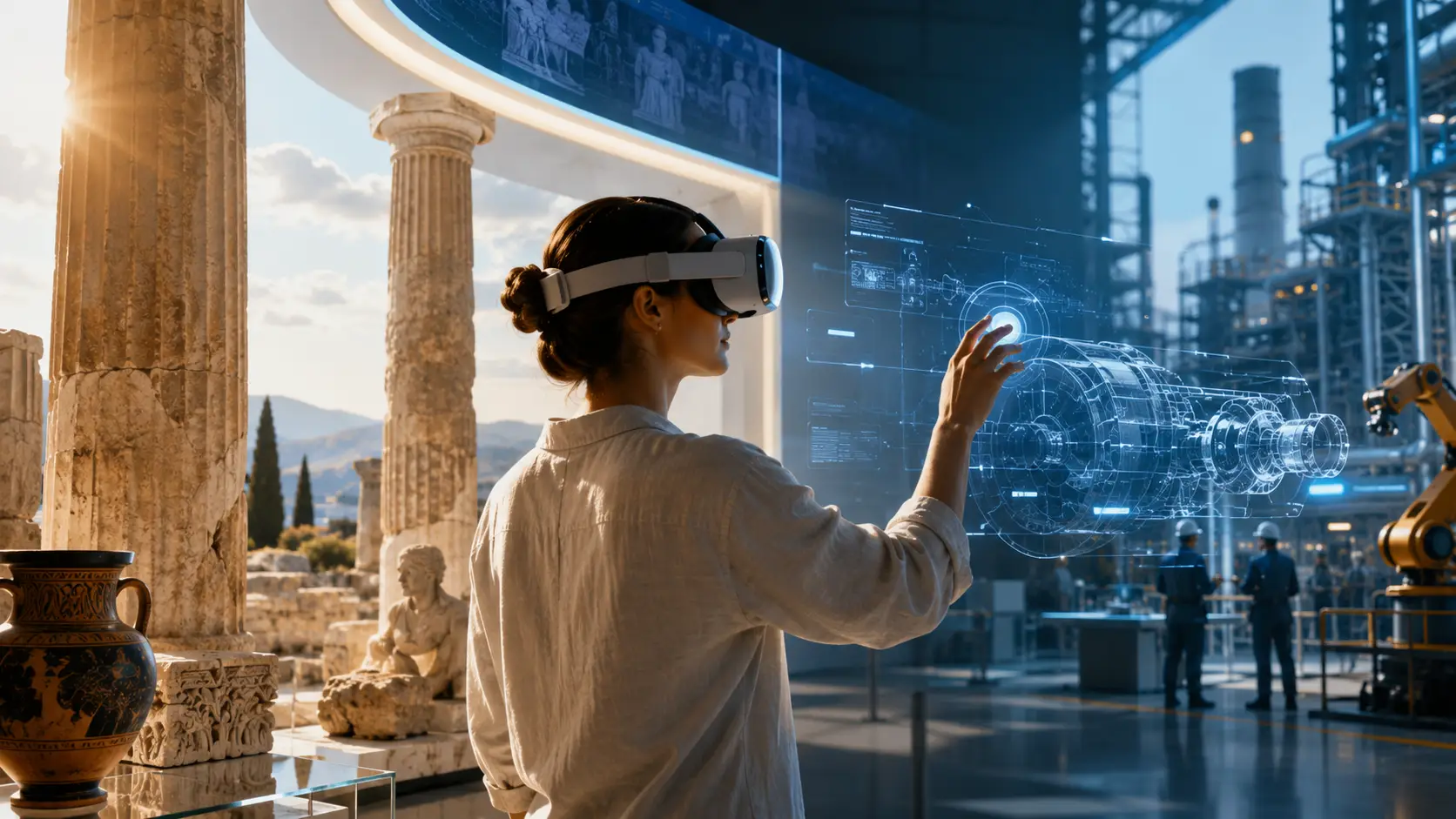
The phrase “VR experience Greece” means different things to different people. To a tourist in Athens, it might mean an hour at a VR arcade near Monastiraki. To a museum director, it might mean a digital reconstruction of an archaeological site that visitors can walk through. To a defense contractor or an industrial operator, it might mean a training simulation that prevents accidents and shortens learning curves. These are very different products built by different teams for different purposes, and the Greek market increasingly supports all of them.
This article maps the landscape of professionally produced VR experiences in Greece, what each category delivers, and what to look for when commissioning or partnering on one. We write this from the perspective of Fourthedesign, a 3D visualization and AR/VR studio in Heraklion, Crete, that has been building custom VR work since 2003.

The five categories of VR experience in Greece today
Cultural heritage and museum VR
This is the most visible category to the public. It includes reconstructions of archaeological sites, immersive ancient-world tours, interpretation of monuments and artworks, and educational content for schools. The Foundation of the Hellenic World at Hellenic Cosmos in Athens has been pioneering this since the early 2000s with its Tholos VR dome theater. Greek heritage offers an essentially inexhaustible content well, and demand from museums, foundations, and tourism operators continues to grow. See our guide to museum interactive installations for more.
Industrial and operational training
Far less visible to the public, but commercially the most active segment. Greek companies in shipping, energy, logistics, mining, manufacturing, and construction increasingly deploy VR for safety training, equipment familiarization, emergency response, and process simulation. The economics are clear: VR training prevents real-world accidents, accelerates onboarding, and integrates with learning management systems for measurable outcomes.
Defense and aerospace visualization
A specialized category with very specific operational and confidentiality requirements. Greek defense contractors and the Hellenic Armed Forces use VR and mixed reality for concept-of-operations visualization, briefing tools, tactical data link demonstration, and command-and-control system presentation. The work tends to be project-specific, often classified, and built by studios with the right clearances and references.
Architectural and real estate VR
Property developers, architectural firms, and luxury real estate operators use VR walkthroughs and 3D visualization to let clients experience unbuilt buildings, configure materials and finishes interactively, and shorten sales cycles. The Greek real estate market, particularly the luxury and resort segments serving international buyers, has been a strong adopter.
Healthcare and medical VR
Rehabilitation simulations, surgical training, anatomy visualization, and therapeutic applications. Greek universities and hospitals have run several major research projects in this area, often in partnership with EU-funded consortia.
What makes a good VR experience
Across all these categories, the differences between a VR experience that succeeds and one that disappoints come down to a small number of recurring factors.
Performance. VR demands consistent high frame rates. An experience running at 30 frames per second produces motion sickness and complaints; one running at 72 or 90 frames per second feels seamless. Achieving this on standalone headsets like Meta Quest 3 or Pico requires real optimization expertise — efficient shaders, level-of-detail systems, draw call management, careful asset budgeting.
Interaction design. A VR experience is not a film. Visitors need to understand what they can do, how to do it, and what happens when they try. Good interaction design respects the medium: it works with hand tracking and controllers, and it gracefully handles visitors who have never worn a headset before.
Content depth. Spectacle without substance fatigues quickly. The VR experiences visitors remember are the ones that taught them something, moved them emotionally, or let them do something they could not do otherwise. This depends as much on the writers, historians, and subject matter experts as on the technology.
Operational design. Every VR experience must be deployed and operated. Who charges the headsets? Who cleans them between visitors? Who handles a visitor who feels nauseous? Who reboots the system when something hangs? Teams that have actually deployed and operated their work include the answers to these questions.
Integration. A standalone VR experience that exists in its own bubble is harder to justify commercially than one integrated with the surrounding business. A museum VR should tie into ticketing and visitor analytics. An industrial training VR should report results to the company’s LMS. Integration is where VR moves from showcase to tool.
Hardware choices that matter
Most Greek VR projects in 2026 deploy on one of four hardware tiers, each with different cost and capability implications.
Standalone consumer headsets — Meta Quest 3, Quest 3S, Pico 4 — are the dominant choice for most projects. They are inexpensive, easy to deploy, have credible visual fidelity, and support mixed reality through passthrough. For museums, training rooms, exhibition stands, and most commercial deployments, this tier is the right answer.
PCVR systems — Quest connected to a gaming PC, or HTC Vive systems — deliver higher visual fidelity for projects where it matters: photorealistic architectural visualization, complex industrial simulations, or content with very high asset counts.
Multi-user free-roaming setups — purpose-built rooms where multiple users walk around with mapped headsets — are the most expensive tier and the most spectacular. International studios like Excurio and Small Creative have built their business around this format. Greek deployments at this scale remain rare but are technically feasible and likely to grow.
Dome and CAVE systems — like the Tholos theater at Hellenic Cosmos — are specialist installations that deliver shared immersive experience without headsets. They suit large audiences and specific institutional contexts.
What to ask before commissioning a VR experience
A short checklist for institutions or companies starting a VR project:
- What is the success metric? Visitor satisfaction, training transfer, sales conversion, scientific accuracy, all of the above?
- What is the visitor or user journey, from arrival to departure?
- What hardware will it run on, and who is responsible for maintaining that hardware?
- What integrations are required with existing systems?
- What is the content update plan over the next five years?
- Can the proposed studio show working installations from previous clients?
- What does post-launch support actually look like, in writing?
Studios that handle these questions with confidence tend to deliver projects that succeed. Studios that wave them away tend to deliver problems.
Working with Fourthedesign
Fourthedesign builds custom VR experiences for museums, defense contractors, industrial operators, architects, healthcare institutions, and EU research consortia. We work across Unity URP/HDRP, Unreal Engine, and WebXR, optimizing for Meta Quest 3, Pico, PCVR, and large-scale installation hardware. Our portfolio spans cultural heritage reconstructions, mixed reality exhibition kiosks for defense systems, industrial training simulations, architectural walkthroughs, and AR applications deployed at scale.
If you are evaluating a VR project in Greece — whether for a single venue, a touring exhibition, an internal training programme, or a defense or industrial application — see our portfolio or contact Fourthedesign to start the conversation.
