



3D Virtual Tour Company in Greece: How to Choose the Right Studio
Looking for a Greek company to create a 3D virtual tour? Fourthedesign is a creative technology studio based in Heraklion, Crete, Greece. We develop custom interactive 3D environments, real-time web walkthroughs and virtual reality experiences for architecture, real estate, cultural heritage and other uses. The right solution depends on the space, source material, visitor experience and devices—not merely the label “virtual tour.”
A photographic 360° tour of an existing hotel, a 3D walkthrough of an unbuilt residential development and an immersive reconstruction of a historic monument are different kinds of production. They require different data, interfaces, hardware and budgets. This article explains how to choose a 3D virtual tour company in Greece, what deliverables to request and how to assess providers using relevant examples rather than marketing superlatives.
We will also show three real Fourthedesign projects: the ENIGMA interactive Web 3D real estate explorer, a Kourtidis Group property VR walkthrough and a Unity VR project using Gaussian Splatting reconstructions of four historic monasteries in Crete.

What Does a 3D Virtual Tour Company Do?
A virtual tour allows someone to explore a place remotely. The visitor may look around, move between viewpoints or navigate a continuous digital environment. More sophisticated experiences can include clickable information, maps, product selection, property filters, guided routes and multimedia. The important question is what the user should understand or do after opening the experience.
Some studios focus on panoramic photography and scanning. Others specialize in 3D visualization, WebGL applications or immersive VR. These capabilities can overlap, but they are not interchangeable. A provider who produces beautiful photographs may not be able to create a custom interactive sales application, and a real-time 3D developer may not be the best fit for a straightforward photography-only commission.
Before requesting a quotation, define whether you need visual documentation of an existing place, presentation of a planned space, interactive navigation or a technical application connected to data. Asking that question early prevents an attractive but unsuitable deliverable.

Types of Virtual Tours: 360°, Web 3D, VR and Reality Capture
360-Degree Photographic Tours
Panoramic photography is useful when an existing interior needs to be shown accurately from selected viewpoints. Visitors can rotate their view and move through a series of linked images. Hotels, restaurants, villas, retail shops and finished apartments are common examples. Navigation is usually based on captured camera positions rather than free movement through an editable 3D scene.
Ask whether the price includes all required viewpoints, retouching, floor-plan navigation, branding, hotspots and hosting. If a client needs measured dimensions or an editable architectural model, those requirements must be specified separately. A photographic tour is not automatically a certified building survey.
Interactive Web 3D Walkthroughs
Web 3D applications allow richer custom behavior. A visitor might select a building in a masterplan, open information about a unit, switch between predefined viewpoints or filter a list of available spaces. The environment can be built from CAD/BIM material, existing 3D assets or new models designed for real-time rendering.
Browser accessibility is valuable because viewers may not need to install software. However, the experience still needs optimization for load time, screen size, touch controls and different graphics capabilities. Fourthedesign’s Digital Twins & Interactive 3D service covers this type of spatial presentation and application development.
VR Walkthroughs with Headsets
Virtual reality provides an immersive sense of scale and presence. It is particularly relevant when a client wants prospective buyers, exhibition visitors or trainees to understand how a space feels. The application can use guided paths or more flexible navigation depending on the learning or presentation objective.
Headset models have different performance limits. VR comfort, device management, physical clearance and operator support should be considered, especially at events. A headset-based version does not automatically mean the experience will run in a smartphone browser; both may require distinct builds and interfaces.
Photogrammetry and 3D Gaussian Splatting
Photographs and drone footage can be used to reconstruct an existing environment. Gaussian Splatting is a technique for generating realistic-looking spatial scenes from image-based information, especially in places that would require substantial manual modeling. It is relevant to cultural heritage, outdoor locations and other visually complex spaces.
Photorealism is not the same as geometrical accuracy. Projects requiring verified measurements, editable objects or BIM compatibility may need a complementary mesh, survey or CAD/BIM workflow. If a supplier offers Gaussian Splatting, ask how it will be used in the viewer and which interactions and platforms can be supported.
Three Real Fourthedesign Projects to Evaluate
One of the best ways to evaluate a 3D virtual tour provider is to inspect actual work. Request a demo from an appropriate industry, ask what the company delivered and review whether the product meets the technical requirements of your own project. Fourthedesign’s portfolio includes the following different approaches.
ENIGMA: Browser-Based Real Estate Exploration
ENIGMA is an interactive Web 3D real estate explorer that demonstrates spatial navigation connected to property presentation. Instead of relying only on flat images, viewers can explore a development and inspect relevant information in context. This approach is useful when a project includes multiple buildings, units or a masterplan that would otherwise be difficult to understand.
Web 3D interfaces may support filters, selectable buildings and unit-level details, but any specific live pricing or CRM integration must be included in a separate technical scope. Those features should not be inferred from screenshots alone.
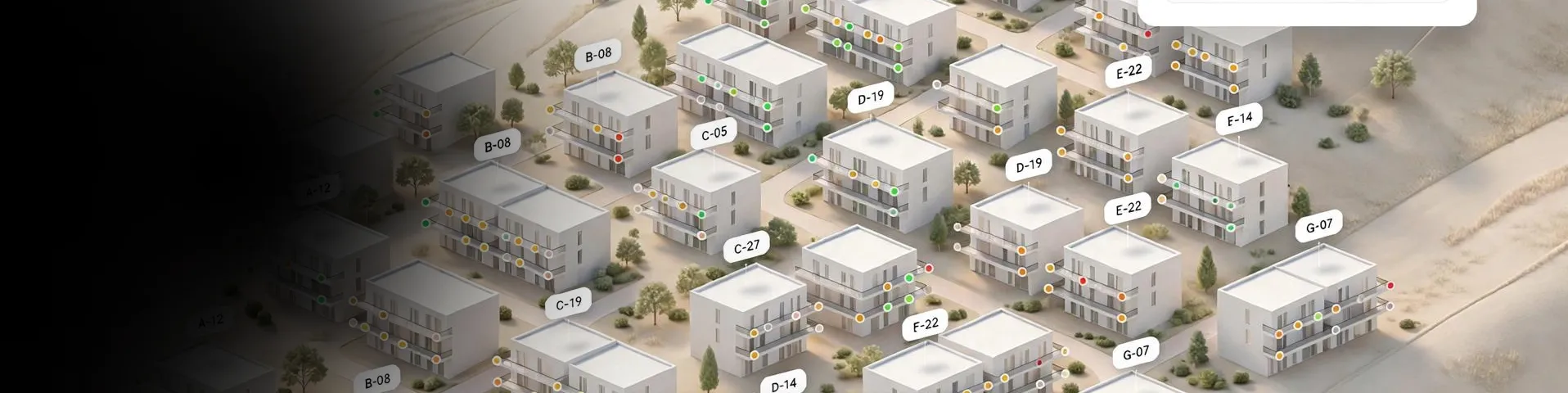
See the ENIGMA interactive Web 3D real estate explorer for an overview of the approach.
Kourtidis Group: Architectural VR Property Walkthrough
Fourthedesign’s Kourtidis Group VR property walkthrough illustrates immersive architectural presentation. In real estate, a virtual environment can help people appreciate rooms, proportions and spatial connections before or alongside a physical visit. For planned projects, source drawings and design references provide the basis for the experience.
When commissioning this kind of walkthrough, specify whether the project needs free movement, guided presentation, alternate materials, multiple views or visual output for marketing. Also define what hardware will be used for demonstrations, which level of accuracy is required and whether updated architectural plans may lead to revisions.

Four Historic Monasteries in Crete: Gaussian Splatting and Unity VR
Fourthedesign captured drone footage of four historic monasteries in Crete: Apezanon, Odigitria, Varsamonero and Vrontisi. The material was used for four photorealistic 3D Gaussian Splatting reconstructions, which were integrated into an interactive Unity VR application. This case is an example of reality capture leading to immersive digital exploration.
The experience helps present historic architecture and its surroundings to visitors. It is a visual reconstruction, not an engineering-grade survey, a fully editable BIM building model or a continuously synchronized operational digital twin. That distinction matters if a client is preparing measurements, technical restoration work or facility management.
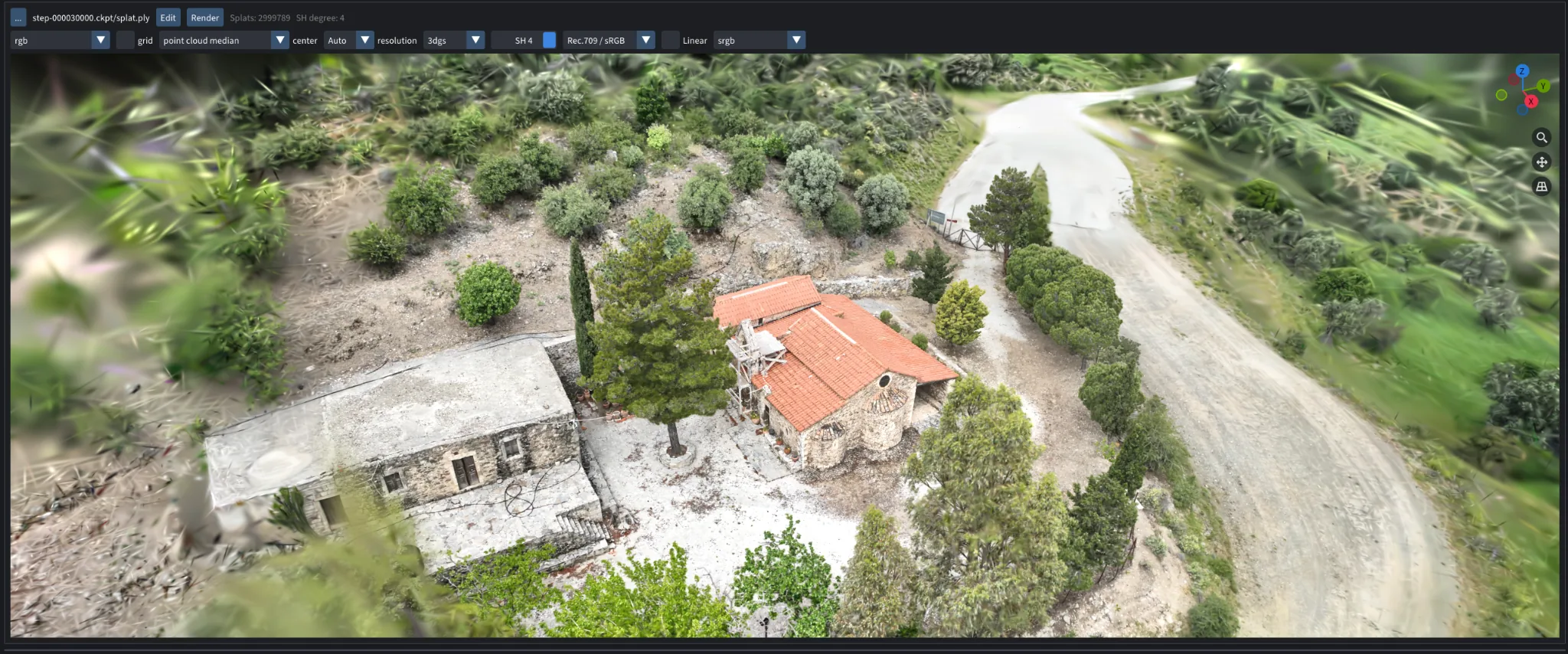
Explore the Gaussian Splatting and VR historic monasteries case study for real project material.
How to Choose the Right Virtual Tour Provider in Greece
Ask for Relevant Projects and Usable Demos
Choose providers based on experience with a similar use case, not just claims such as “best virtual tour company.” A photography tour of a restaurant does not prove the ability to develop a real-time 3D application, while a game-engine demo may not demonstrate the capture process required for an existing heritage site.
Request a working demonstration and test it on realistic hardware. Ask whether the company created the 3D content, wrote the interactive software, handled onsite capture or collaborated with another specialist. A clear description of roles provides more useful evidence than an unqualified claim to have built everything.
Compare Complete Deliverables, Not Just the Initial Price
Does the quote include location capture, 3D modeling, navigation, hotspots, branding, images, multiple languages, testing and deployment? Is the result a web link, an application or downloadable source material? If additional content is needed after delivery, how will that be handled?
Request a list of included features and optional extensions. If the property or development changes, you may need to update parts of the tour; maintenance conditions are therefore an important part of total project cost.
Check Mobile, Desktop and VR Requirements
Ask for a device compatibility matrix. Web-based applications should be tested across representative browsers and mobile devices; VR applications should be tested on the specific headsets in scope. Confirm navigation, text readability, loading time and comfort. A strong desktop demonstration may still require considerable optimization for standalone VR or a smartphone.
Discuss Ownership, Hosting and Data
Confirm who owns source files and final assets, which usage rights apply and whether the viewer depends on a subscription or hosting platform. The contract should explain how long the content will stay online and what happens if the company changes its provider.
For commercial properties or sensitive facilities, discuss which areas may appear publicly and who will approve the images. If the system connects to occupancy, availability or asset databases, data security, access permissions and updates become separate technical requirements.
Clarify Visual Accuracy Versus Measured Geometry
A photorealistic scene might look convincing without meeting measurement tolerances. A CAD/BIM model may contain useful technical geometry without a photographic appearance. Before requesting an accurate virtual tour, decide whether the goal is marketing, orientation, training or engineering. The acceptance tests must match that goal.
Who Needs a 3D Virtual Tour?
Hotels, Resorts and Holiday Villas
Potential guests often want to understand room layouts, outdoor areas and amenities. An up-to-date tour can help them evaluate whether the property matches their needs, especially when the visitor is located abroad. For completed interiors, panoramic photography might be sufficient; for planned developments or extensive interactive maps, custom 3D may be a better fit.
Real Estate and Architectural Developments
Property developers can show masterplans, building exteriors, interiors and relationships between spaces before construction. They may also need selectable units or contextual information. Those functions turn the virtual tour into part of a property presentation workflow. Related work includes Fourthedesign’s architectural 3D visualization solutions and ENIGMA.
Museums, Historic Sites and Destinations
Heritage organizations may want visitors to explore sites that are difficult to access, understand historical settings or experience reconstructed environments. Clear distinctions should be made between actual photographic capture, documented architectural evidence and hypothetical reconstructions. Guided interpretation can make the experience more educational than a simple visual fly-through.
Showrooms, Corporate Spaces and Industry
Virtual showrooms can make products selectable and link them to specifications, while company environments can help with visitor orientation or remote presentations. An industrial tour may involve technical information or training sequences, but it should not be presented as a safety certification or live digital twin without those functions being designed and validated.
How Much Does a 3D Virtual Tour Cost in Greece?
There is no meaningful universal price for “a 3D virtual tour.” A basic series of panoramic views involves different work from a custom Web 3D sales platform or an immersive VR application. The required source material, number of spaces, level of interaction and target devices can change the budget substantially.
Key cost factors include size and complexity, capture or modeling effort, number of locations, realism, interaction design, device optimization, content languages, hosting and support. Travel, permissions, hardware purchase or rental and backend integrations should be explicitly included or excluded in the quotation.
For a practical comparison, ask suppliers to separate the pilot or initial scene, full production, optional features and ongoing expenses. A small prototype can confirm navigation, performance and visual quality before a client commits to a larger site. This makes the decision easier to evaluate and reduces the risk of paying for a technically impressive but commercially unsuitable experience.
Budget should be considered together with maintenance. A tour that cannot be updated easily after a renovation or a change in the development may be more expensive in the long run, even if the initial price is low.
What Does the Production Process Look Like?
- Discovery: identify the audience, key spaces, communication goals and target devices.
- Source review: assess CAD/BIM drawings, reference photographs, existing models, capture access and technical accuracy needs.
- Approach selection: decide on panoramas, conventional 3D, Gaussian Splatting, Web 3D or VR, based on the deliverable.
- Prototype: test a representative room, viewpoint or user action before full production.
- Implementation: build scenes, navigation, information panels, optional filters and other interactions.
- Testing: check supported browsers, mobile and headsets, and verify content against the approved brief.
- Delivery: provide the agreed viewer, files, hosting setup and maintenance process.
Every project has its own dependencies. A client who supplies clean 3D models may need less asset preparation than a client commissioning drone capture and extensive reconstruction. Likewise, a static tour may be delivered through a simpler workflow than a platform with custom data connections.
Why Consider Fourthedesign as Your Greek 3D Tour Studio?
Fourthedesign develops interactive 3D and VR experiences from Greece. We focus on the spatial content and interaction layer: how users navigate, what they see, which details they can select and how the experience runs on its intended platform. Our real examples span web-based real estate, architectural VR and image-based reconstruction of cultural heritage sites.
The right approach is to start with the project goal, not to force every client into the same technology. A photorealistic tour may be useful for communication, while a custom interactive environment can support additional data and actions. Neither automatically becomes a full operational digital twin without appropriate integrations.
We can assess your source material and explain the production options, limitations and likely scope. That is more useful for a business buyer than unsupported claims about a guaranteed number-one ranking or universal compatibility with every headset.
Frequently Asked Questions About Virtual Tour Companies in Greece
Can I hire a Greek company for a custom 3D virtual tour?
Yes. Fourthedesign is based in Heraklion, Crete and develops interactive 3D, real-time web and VR experiences. The appropriate delivery format depends on your space, source assets and target users.
Are 360° photos and 3D virtual tours the same thing?
No. A photo tour is typically a set of panoramic viewpoints. A custom real-time 3D application may allow continuous navigation, selectable objects and more complex interactions.
Does a visitor need a VR headset?
Not for a browser-based Web 3D or photographic tour. VR requires compatible hardware and a version designed for the headset.
Can we create a virtual tour before a building is constructed?
Yes. Architectural drawings and models can be used to produce a digital walkthrough of an unbuilt space, with an agreed level of design fidelity.
Can a virtual tour include clickable information and maps?
Yes, when these functions are included in a custom application. Property details, points of interest, guided navigation and links can be connected to a 3D scene.
Can Gaussian Splatting support technical measurements?
A visually realistic Gaussian Splatting reconstruction is not automatically a verified survey. Projects requiring accurate dimensions need suitable measurement methods and validation.
How can I estimate the cost?
Share the number and type of spaces, existing material, device targets, interactions, languages and maintenance needs. A scoped pilot or detailed brief allows a meaningful quotation.
What real projects demonstrate Fourthedesign’s expertise?
ENIGMA is an interactive Web 3D property explorer, Kourtidis Group is an architectural VR walkthrough, and the historic monastery project integrates Gaussian Splatting reconstructions into Unity VR.
Discuss Your 3D Virtual Tour Project
If you want to make a property, cultural site, showroom or technical environment accessible through an interactive digital experience, start by sharing the location, available source material and purpose. Fourthedesign can help determine whether a real-time Web 3D application, immersive VR walkthrough or image-based spatial reconstruction is the right production path.
Read more about Digital Twins & Interactive 3D, review ENIGMA, see the historic monastery VR project and contact Fourthedesign to discuss a practical brief.

