



VR Medical Training for Janssen: Ulcerative Colitis in VR
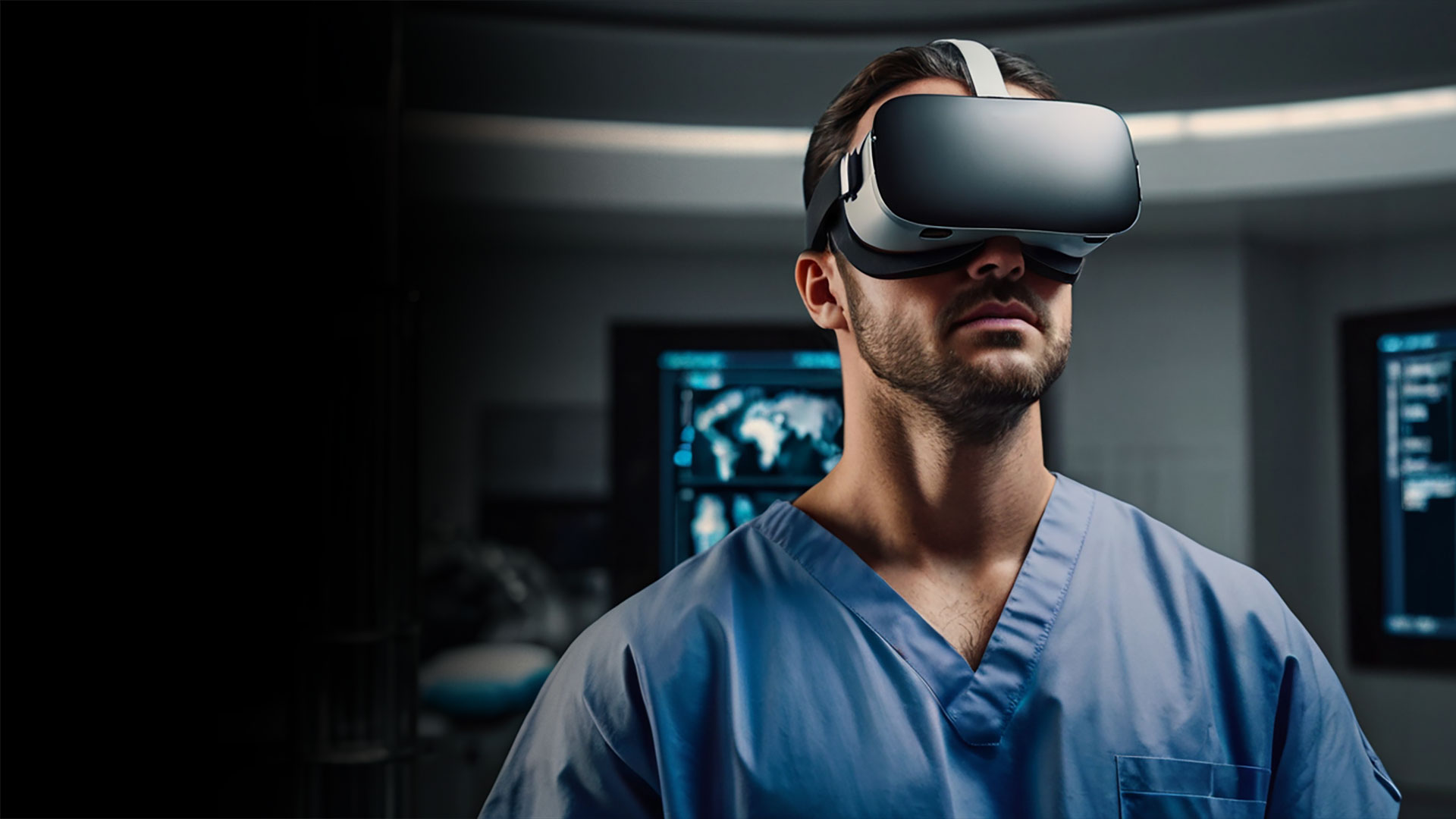
Case study – VR medical training
Inside the gut: VR medical training for Janssen on Ulcerative Colitis
A medical VR experience developed by Fourthedesign for Janssen, moving from an illustrated lifestyle setting into the microscopic world of the gut mucosa in ulcerative colitis.
Client
Janssen – Johnson & Johnson
Year
2020-2021
Industry
Medical & Healthcare · Pharmaceutical · Medical Education
Platform
VR headset – PCVR
Services
3D medical animation
3D modeling
Character rigging
Clinical environment design
Storyboard design
The challenge
Ulcerative Colitis is invisible to the naked eye. VR made it visible.
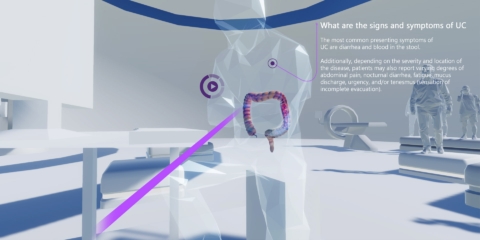
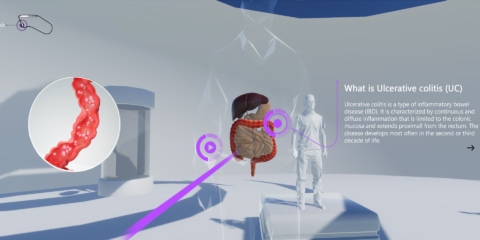
Ulcerative colitis (UC) is a chronic inflammatory bowel disease affecting the inner lining of the colon. Immune responses, the intestinal barrier, the microbiome and environmental influences are among the factors studied in relation to the disease. Its biological processes can be difficult to convey through conventional diagrams alone.
For medical and scientific audiences, immersive 3D visualization offers a complementary way to illustrate mucosal inflammation and epithelial changes alongside established medical explanations.
Fourthedesign developed this VR presentation for Janssen as a spatial educational experience, moving from a human-scale scene into a digitally illustrated intestinal microenvironment. It is intended for scientific communication, not for diagnosis or clinical decision-making.
Our approach
We built two worlds: the patient environment and the microscopic disease mechanism.
Macro lifestyle environment
The introductory scene depicts aspects of contemporary life through animated characters and environmental details. These elements establish the setting for the medical narrative; they should not be interpreted as proof that particular foods, inactivity or psychological stress directly cause ulcerative colitis.
Animated clinical characters
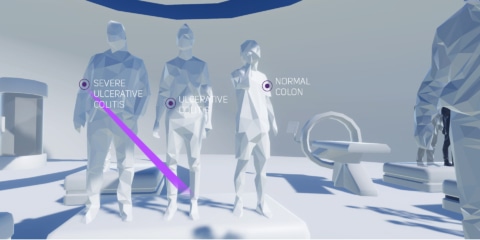
Characters were fully rigged and animated, not placed as static props. Their movement, posture, and presentation supported the educational narrative and helped communicate the lifestyle and systemic context around UC.
Gut mucosa microenvironment
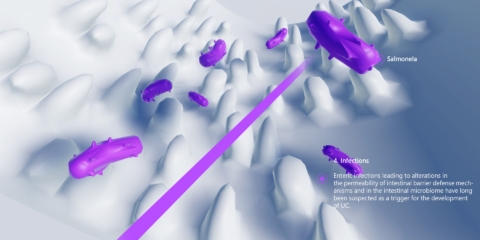
At the micro level, the experience transitions into the gut mucosa itself. Epithelial cell dysfunction, disruption of tight junctions, inflammatory infiltrate, and mucosal inflammation are presented in real-time 3D at a scale impossible in conventional media.
Medical-reference-led storytelling
Storyboards structured the scientific narrative before 3D production. Anatomy and cellular scenes were developed with medical reference material in mind; scientific interpretations should be checked by qualified clinical specialists before reuse.
Medical VR helps physicians understand complex biology spatially.
01
Make the invisible visible
VR allows physicians to enter the gut mucosa and observe mechanisms that cannot be experienced directly through standard medical materials.
02
Connect context to mechanism
The experience moves from the introductory setting to cellular-level visualizations, connecting the narrative context with the biological processes being illustrated.
03
Support HCP education
The format gives medical affairs and pharmaceutical teams an engaging tool for physician education, congress activity, and scientific communication.
04
Support scientific discussion
A spatial representation offers another way to explain and discuss complex concepts. The project page does not claim clinically measured improvements in learning or retention.
Experience flow
From an introductory scene to the intestinal microenvironment.
Introductory setting
The user begins in an illustrated everyday-life setting, presented through environmental details and character animation, before moving into the scientific scenes.
Clinical framing
The experience introduces signs, symptoms, systemic effects, and the distinction between healthy and inflamed colon states.
Scale transition
The user moves from the human-level environment into the microcosmos of the gut mucosa.
Cellular mechanism
Epithelial dysfunction, mucosal inflammation, and immune activity are visualized as spatial processes rather than flat diagrams.
Clinical understanding
The experience connects what physicians see in patients with the underlying biological mechanisms driving the disease.
Clinical design
In medical VR, accuracy is not decoration. It is the product.
Medical VR requires particular care with scientific representation. Anatomical structures, cell morphology and tissue appearance must serve the educational message without being confused with direct clinical observation.
The production combined storyboard planning, research using medical references, 3D modeling, animation and integration into the VR experience. The creative process focused on visual clarity and coherent scientific storytelling.
Technical stack
A medical VR environment designed for scientific communication.
The result
An immersive VR medical education experience that takes physicians from UC risk context deep into the gut mucosa, where epithelial dysfunction and inflammation become visible.
What this demonstrates
VR provides a spatial way to communicate complex medical concepts.
Pharmaceutical and medical device companies are increasingly using immersive technology as a physician engagement and education tool for conferences, medical affairs programmes, HCP communications, and clinical visualization.
The Janssen ulcerative colitis experience illustrates how storyboard-led 3D production and immersive viewing can support scientific communication. Clinical accuracy and educational effectiveness must be assessed separately from visual quality.
Fourthedesign is a VR/AR and 3D medical animation studio based in Heraklion, Crete, Greece. We develop immersive medical experiences, pharmaceutical VR applications, and scientific visualizations. Learn more about our medical 3D animation work and consult the NIDDK ulcerative colitis overview for medical background.
Project questions
Janssen Medical VR: Project Questions
What does the VR experience visualize?
It depicts concepts related to ulcerative colitis, moving from an everyday-life setting into the intestinal mucosa and its illustrated inflammatory processes.
Who created the 3D and VR experience?
Fourthedesign created the immersive production, including environments, medical 3D content, animation and the VR presentation for Janssen.
Is the experience a diagnostic or treatment tool?
No. This is scientific and educational visualization; it is not presented as a tool for diagnosing or treating ulcerative colitis.

